
Big Ten Schools Academic Rankings: The Best Big Ten Universities for 2026
The best 2026/2027 Big Ten schools academically in Waystone's ranking are Northwestern, USC and Michigan. UCLA and Washington round out the top five. The conference is now much larger than the original ten universities and has grown to 18 members.
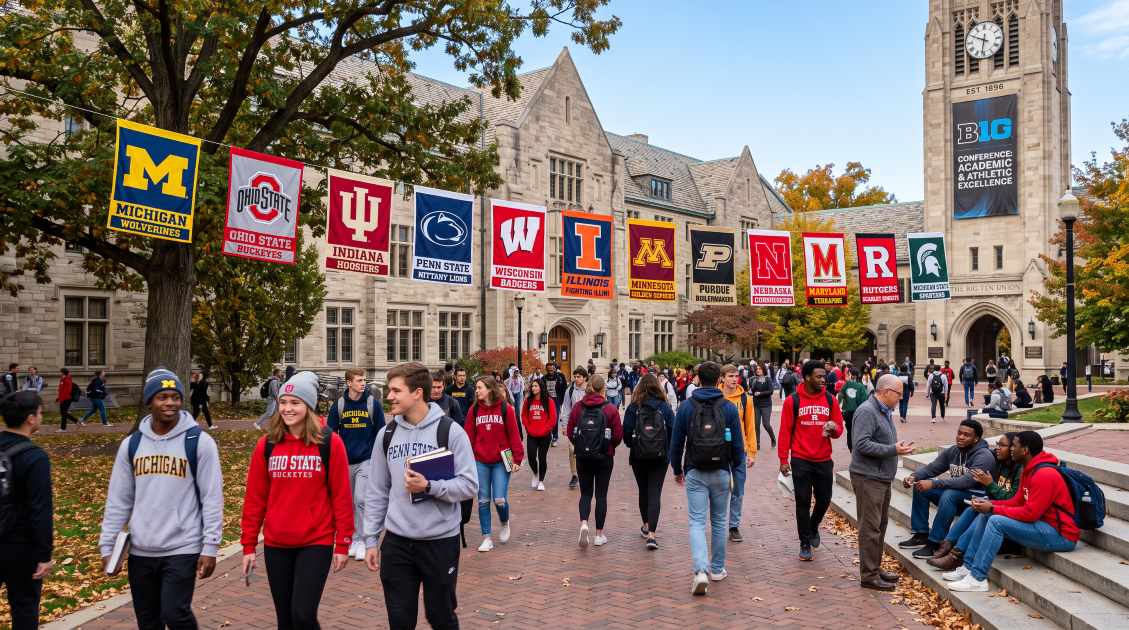
Do some students pick a Big Ten school by its football team? Probably, yes. A brand is easy to see, and outcomes are not. That’s why we wrote this article. These Big Ten schools academic rankings compare all 18 members against each other.
Already have a few Big Ten schools in mind? Create a free account and enter your student's profile so you're ready to compare them side by side.
Key Takeaways
- Northwestern (98.8), USC (92.0) and Michigan (91.2) lead Waystone’s 2026 Big Ten schools academic rankings, followed by UCLA (85.4) and Washington (80.7).
- Michigan is the top public university in the Big Ten. It also posts the conference’s highest major-level scores: 97.7 in computer and information sciences and 97.1 in business administration.
- Northwestern is the hardest Big Ten school to get into, admitting 7.7% of applicants. UCLA (9.0%) and USC (9.8%) come next.
- Every Big Ten school scores 95 or higher on Waystone’s national 10-year ROI scale. So the gaps in this ranking come mostly from debt and student support.
- Overall rank and major rank often differ: Ohio State ranks 10th overall but 1st in subject-area teacher education, and Illinois ranks 8th overall but 1st in agricultural business.
Big Ten schools academic rankings at a glance
Northwestern holds the top spot by almost seven points. The table below shows all 18 members side by side. Acceptance rates, undergraduate enrollment and top majors come from the U.S. Department of Education’s College Scorecard, checked in October 2026. Top majors are the three fields with the most bachelor’s degrees awarded in the latest year reported.
- State
- IL
- Type
- Private
- Acceptance rate
- 7.7%
- Undergrads
- 9,201
Top graduating majorsEconomics, radio, TV and digital communication, psychology
- State
- CA
- Type
- Private
- Acceptance rate
- 9.8%
- Undergrads
- 20,443
Top graduating majorsBusiness (management sciences), computer science, communication
- State
- MI
- Type
- Public
- Acceptance rate
- 15.6%
- Undergrads
- 34,177
Top graduating majorsComputer and information sciences, experimental psychology, business administration
- State
- CA
- Type
- Public
- Acceptance rate
- 9.0%
- Undergrads
- 33,475
Top graduating majorsEconomics, psychology, sociology
- State
- WA
- Type
- Public
- Acceptance rate
- 39.2%
- Undergrads
- 31,942
Top graduating majorsComputer and information sciences, experimental psychology, computer science
- State
- MD
- Type
- Public
- Acceptance rate
- 44.8%
- Undergrads
- 30,760
Top graduating majorsComputer science, information science, biology
- State
- WI
- Type
- Public
- Acceptance rate
- 45.2%
- Undergrads
- 36,902
Top graduating majorsComputer and information sciences, psychology, economics
- State
- IL
- Type
- Public
- Acceptance rate
- 42.4%
- Undergrads
- 36,258
Top graduating majorsExperimental psychology, computer engineering, accounting
- State
- NJ
- Type
- Public
- Acceptance rate
- 58.2%
- Undergrads
- 37,751
Top graduating majorsComputer and information sciences, psychology, finance
- State
- OH
- Type
- Public
- Acceptance rate
- 60.6%
- Undergrads
- 45,638
Top graduating majorsFinance, experimental psychology, biology
- State
- MN
- Type
- Public
- Acceptance rate
- 79.8%
- Undergrads
- 31,855
Top graduating majorsComputer science, psychology, interdisciplinary studies
- State
- IN
- Type
- Public
- Acceptance rate
- 49.9%
- Undergrads
- 44,503
Top graduating majorsComputer science, mechanical engineering, computer engineering
- State
- PA
- Type
- Public
- Acceptance rate
- 60.6%
- Undergrads
- 42,284
Top graduating majorsFinance, information science, computer and information sciences
- State
- IA
- Type
- Public
- Acceptance rate
- 83.6%
- Undergrads
- 22,264
Top graduating majorsKinesiology, finance, behavioral sciences
- State
- IN
- Type
- Public
- Acceptance rate
- 78.2%
- Undergrads
- 37,806
Top graduating majorsBusiness, public administration, kinesiology
- State
- MI
- Type
- Public
- Acceptance rate
- 84.8%
- Undergrads
- 40,922
Top graduating majorsBiology, psychology, business administration
- State
- OR
- Type
- Public
- Acceptance rate
- 88.3%
- Undergrads
- 20,497
Top graduating majorsBusiness, public relations and advertising, experimental psychology
- State
- NE
- Type
- Public
- Acceptance rate
- 87.5%
- Undergrads
- 19,178
Top graduating majorsBusiness administration, psychology, finance
Want to see how one major plays out across the conference? Search any major on Waystone's College Finder to compare completion rates, median earnings and ROI at every school that offers it.
Big Ten schools ranked academically
Waystone’s holistic methodology includes these inputs that build each school’s composite score:
- Debt payoff score: what a graduate owes, measured against what they earn, benchmarked nationally. That ratio is scored 0–100 against colleges nationwide. A lower ratio scores higher.
- 10-year ROI: This is the raw return on the cost of the degree, as a percentage, compared against what a full-time worker with only a high school diploma earns.
- 10-year ROI percentile: return on investment over a decade, ranked the same way against colleges nationwide.
- Institutional strength percentile: retention rate, student-faculty ratio, Pell-recipient completion equity and library investment per student, averaged from whichever of those four a school reports. That ratio is scored 0–100 against SEC schools. A higher ratio scores higher.
Important Note: ROI calculations use in-state tuition data for public institutions as that is the only data the Department of Education tracks. This means out of state students may have a lower ROI value for those Universities.
Its undergraduate learning sciences major was the first of its kind when it opened in 2016.
Score breakdown
- Debt Payoff Score
- 99.3
- 10-year ROI
- 115.6%
- 10-year ROI percentile
- 100.0
- Institutional Strength (Big Ten)
- 97.2
- Retention percentile
- 97.2
- Student-faculty percentile
- 97.2
- Pell equity percentile
- 97.2
- Library percentile
- 97.2
Its School of Cinematic Arts, founded in 1929, is the oldest film school in the nation.
Score breakdown
- Debt Payoff Score
- 91.4
- 10-year ROI
- 73.9%
- 10-year ROI percentile
- 100.0
- Institutional Strength (Big Ten)
- 84.7
- Retention percentile
- 69.4
- Student-faculty percentile
- 91.7
- Pell equity percentile
- 91.7
- Library percentile
- 86.1
Mcity was the world’s first proving ground built for connected and self-driving vehicles.
Score breakdown
- Debt Payoff Score
- 87.5
- 10-year ROI
- 320.0%
- 10-year ROI percentile
- 100.0
- Institutional Strength (Big Ten)
- 86.1
- Retention percentile
- 91.7
- Student-faculty percentile
- 86.1
- Pell equity percentile
- 75.0
- Library percentile
- 91.7
The most applied-to four-year university in the nation, with 173,374 applications for fall 2025.
Score breakdown
- Debt Payoff Score
- 92.2
- 10-year ROI
- 46.9%
- 10-year ROI percentile
- 100.0
- Institutional Strength (Big Ten)
- 63.9
- Retention percentile
- 86.1
- Student-faculty percentile
- 8.3
- Pell equity percentile
- 80.6
- Library percentile
- 80.6
Receives more federal research dollars than any other U.S. public university.
Score breakdown
- Debt Payoff Score
- 93.0
- 10-year ROI
- 100.3%
- 10-year ROI percentile
- 100.0
- Institutional Strength (Big Ten)
- 48.6
- Retention percentile
- 58.3
- Student-faculty percentile
- 8.3
- Pell equity percentile
- 58.3
- Library percentile
- 69.4
The only ABET-accredited undergraduate fire protection engineering program in the U.S.
Score breakdown
- Debt Payoff Score
- 84.8
- 10-year ROI
- 156.7%
- 10-year ROI percentile
- 100.0
- Institutional Strength (Big Ten)
- 54.9
- Retention percentile
- 80.6
- Student-faculty percentile
- 44.4
- Pell equity percentile
- 63.9
- Library percentile
- 30.6
Operates the IceCube Neutrino Observatory; its lead scientist won the 2026 Nobel Prize in Physics.
Score breakdown
- Debt Payoff Score
- 75.6
- 10-year ROI
- 38.1%
- 10-year ROI percentile
- 100.0
- Institutional Strength (Big Ten)
- 53.5
- Retention percentile
- 75.0
- Student-faculty percentile
- 27.8
- Pell equity percentile
- 86.1
- Library percentile
- 25.0
17 or more blended CS + X degrees that pair computer science with another field.
Score breakdown
- Debt Payoff Score
- 81.3
- 10-year ROI
- 128.4%
- 10-year ROI percentile
- 100.0
- Institutional Strength (Big Ten)
- 40.3
- Retention percentile
- 63.9
- Student-faculty percentile
- 8.3
- Pell equity percentile
- 41.7
- Library percentile
- 47.2
The only U.S. university that is a colonial college, a land-grant school and a public research university.
Score breakdown
- Debt Payoff Score
- 72.8
- 10-year ROI
- -1.9%
- 10-year ROI percentile
- 99.6
- Institutional Strength (Big Ten)
- 49.3
- Retention percentile
- 47.2
- Student-faculty percentile
- 66.7
- Pell equity percentile
- 69.4
- Library percentile
- 13.9
Seven health sciences colleges on one campus, which Ohio State says no other major university has.
Score breakdown
- Debt Payoff Score
- 66.4
- 10-year ROI
- -103.6%
- 10-year ROI percentile
- 97.0
- Institutional Strength (Big Ten)
- 54.9
- Retention percentile
- 52.8
- Student-faculty percentile
- 66.7
- Pell equity percentile
- 47.2
- Library percentile
- 52.8
One of five universities with agriculture, engineering, law, medicine and veterinary medicine on one campus.
Score breakdown
- Debt Payoff Score
- 75.2
- 10-year ROI
- -6.2%
- 10-year ROI percentile
- 99.5
- Institutional Strength (Big Ten)
- 42.4
- Retention percentile
- 30.6
- Student-faculty percentile
- 44.4
- Pell equity percentile
- 30.6
- Library percentile
- 63.9
Base tuition frozen for 14 straight years, through 2026-27.
Score breakdown
- Debt Payoff Score
- 77.9
- 10-year ROI
- 56.7%
- 10-year ROI percentile
- 100.0
- Institutional Strength (Big Ten)
- 36.1
- Retention percentile
- 41.7
- Student-faculty percentile
- 80.6
- Pell equity percentile
- 19.4
- Library percentile
- 2.8
THON, the largest student-run philanthropy in the world, raised a record $18.8 million in 2026.
Score breakdown
- Debt Payoff Score
- 56.0
- 10-year ROI
- -70.1%
- 10-year ROI percentile
- 97.9
- Institutional Strength (Big Ten)
- 53.5
- Retention percentile
- 36.1
- Student-faculty percentile
- 66.7
- Pell equity percentile
- 52.8
- Library percentile
- 58.3
The Iowa Writers’ Workshop, founded in 1936, was the nation’s first creative writing degree program.
Score breakdown
- Debt Payoff Score
- 59.8
- 10-year ROI
- -88.8%
- 10-year ROI percentile
- 97.4
- Institutional Strength (Big Ten)
- 43.8
- Retention percentile
- 19.4
- Student-faculty percentile
- 66.7
- Pell equity percentile
- 13.9
- Library percentile
- 75.0
The Luddy School was the first school of informatics in the U.S. when it opened in 2000.
Score breakdown
- Debt Payoff Score
- 70.3
- 10-year ROI
- -73.4%
- 10-year ROI percentile
- 97.8
- Institutional Strength (Big Ten)
- 25.7
- Retention percentile
- 25.0
- Student-faculty percentile
- 27.8
- Pell equity percentile
- 8.3
- Library percentile
- 41.7
Runs FRIB, the first accelerator-based Department of Energy user facility on a university campus.
Score breakdown
- Debt Payoff Score
- 60.6
- 10-year ROI
- -56.9%
- 10-year ROI percentile
- 98.2
- Institutional Strength (Big Ten)
- 25.7
- Retention percentile
- 13.9
- Student-faculty percentile
- 44.4
- Pell equity percentile
- 25.0
- Library percentile
- 19.4
A $1 billion Knight gift in 2026 is launching a new college of engineering.
Score breakdown
- Debt Payoff Score
- 58.1
- 10-year ROI
- -163.2%
- 10-year ROI percentile
- 95.5
- Institutional Strength (Big Ten)
- 25.0
- Retention percentile
- 8.3
- Student-faculty percentile
- 19.4
- Pell equity percentile
- 36.1
- Library percentile
- 36.1
Offers a bachelor’s in emerging media arts that the university calls the only major of its kind.
Score breakdown
- Debt Payoff Score
- 57.5
- 10-year ROI
- -156.3%
- 10-year ROI percentile
- 95.7
- Institutional Strength (Big Ten)
- 14.6
- Retention percentile
- 2.8
- Student-faculty percentile
- 44.4
- Pell equity percentile
- 2.8
- Library percentile
- 8.3
Why some Big Ten schools show a negative ROI
A negative 10-year ROI does not mean a degree loses money over a career. The formula uses earnings six years after a student first enrolls, which is about two years after a typical graduation. Then it holds those early earnings flat for a decade, with no raises. That’s why Ohio State shows -103.6% while still scoring 97.0 on the national ROI scale.
Quick answers by goal
- Best overall: Northwestern (98.8). Michigan (91.2) is the top public university in the Big Ten.
- Most selective: Northwestern admits 7.7% of applicants. UCLA (9.0%) and USC (9.8%) follow.
- Engineering: UCLA ranks first in mechanical, civil and electrical engineering on Waystone’s major-level scores. Michigan ranks first in aerospace and biomedical engineering.
- Business: Michigan leads in business administration (97.1). Maryland leads in finance, accounting and marketing.2q
- Computer science: Michigan leads in computer and information sciences (97.7), and Washington leads in computer science (78.0).
- In-state value: UCLA has the lowest average net price in the conference, $12,548 a year. Michigan ($13,138) is next.
- Large-university scale: Ohio State enrolls 45,638 undergraduates, the most in the Big Ten. Purdue (44,503) and Penn State (42,284) follow.
So the percentile is the number to watch. All 18 Big Ten schools score 95 or higher on it, which puts every member near the top nationally for return on cost. In other words, this ranking separates good from very good. It does not separate strong schools from weak ones.
Best Big Ten schools by major
The best Big Ten school for your major is often not the best Big Ten school overall. The table below scores each school’s program in a specific major. Schools are ranked only against other Big Ten schools that offer the same major.
Business administration
What to compareDirect admission to the business school, specializations, recruiting
Finance
What to compareInvestment clubs, banking recruiting, CFA-aligned coursework
Accounting
What to compareCPA exam pass rates, 150-hour pathways, firm recruiting
Marketing
What to compareAnalytics coursework, internships, brand partnerships
Computer and information sciences
What to compareCourse access, AI and data options, class size
Computer science
What to compareMajor admission caps, research labs, tech recruiting
Mechanical engineering
What to compareABET accreditation, co-ops, undergraduate research
Civil engineering
What to compareABET accreditation, co-ops, public works internships
Computer engineering
What to compareHardware labs, chip design courses, tech recruiting
Electrical engineering
What to compareLab access, research groups, industry partners
Aerospace engineering
What to compareFlight and propulsion labs, NASA and industry ties
Biomedical engineering
What to compareClinical access, pre-med compatibility
Psychology
What to compareResearch labs, graduate school placement
Biology
What to compareResearch labs, health-professions advising
Economics
What to compareQuantitative depth, research assistant roles
Nursing
What to compareDirect-entry vs. competitive admission, clinical placements, NCLEX pass rates
Journalism
What to compareStudent media, portfolios, internships
Communication studies
What to compareInternships, media access, career services
Public health
What to compareField placements, links to schools of public health
Agricultural business
What to compareLand-grant extension networks, research farms
Subject-area teacher education
What to compareState licensure, student teaching placements
Architecture
What to compareNAAB accreditation, portfolio requirements, studio culture
Best Big Ten schools for different students
The right Big Ten school depends on what you want from college. These pairings use the data above.
- Most selective academic setting: Northwestern, UCLA and USC.
- Private university: Northwestern and USC are the Big Ten’s two private members.
- Huge flagship campus: Ohio State, Purdue and Penn State each enroll more than 42,000 undergraduates.
- In-state value: UCLA, Michigan and Washington have the lowest average net prices.
- Undergraduate research: Washington leads U.S. public universities in federal research dollars, and Michigan and Wisconsin run Mcity and IceCube.
- Pre-health: Ohio State’s seven health colleges and Minnesota’s mix of professional schools stand out.
- You already know your major: use the major table, not the overall rank.
Location matters too. Los Angeles, Seattle, Minneapolis and Columbus put you in large job markets. Meanwhile, Ann Arbor, Madison, Bloomington and Iowa City offer a classic college-town feel.
Not sure which school fits? Choose a Waystone plan to get a full analysis. It sorts schools into reach, good fit and safety based on your GPA, state, major and cost.
Hardest Big Ten schools to get into
Northwestern is the hardest Big Ten school to get into, followed by UCLA and USC. But selectivity and academic quality are not the same thing. A low acceptance rate reflects demand and class size. On its own, it does not tell you which school is better or a better fit.
| School | Acceptance rate | Approx. SAT range | ACT range | Graduation rate | First-year retention |
|---|---|---|---|---|---|
| Northwestern | 7.7% | 1510-1570 | 33-35 | 95.1% | 98.1% |
| UCLA | 9.0% | Not reported | Not reported | 92.6% | 97.3% |
| USC | 9.8% | 1450-1550 | 32-35 | 91.8% | 95.9% |
| Michigan | 15.6% | 1360-1530 | 31-34 | 93.2% | 97.5% |
| Washington | 39.2% | Not reported | Not reported | 85.2% | 94.7% |
| Illinois | 42.4% | 1310-1520 | 30-34 | 85.1% | 94.8% |
| Maryland | 44.8% | 1400-1530 | 32-35 | 88.6% | 96.2% |
| Wisconsin | 45.2% | 1380-1520 | 29-33 | 89.6% | 96.2% |
| Purdue | 49.9% | 1200-1480 | 27-34 | 83.1% | 92.7% |
| Rutgers | 58.2% | 1310-1500 | 28-33 | 83.6% | 93.0% |
| Penn State | 60.6% | 1240-1420 | 27-32 | 86.1% | 92.6% |
| Ohio State | 60.6% | 1310-1480 | 28-32 | 87.7% | 94.2% |
| Indiana | 78.2% | 1170-1400 | 27-33 | 80.2% | 91.1% |
| Minnesota | 79.8% | 1300-1500 | 26-31 | 85.3% | 91.1% |
| Iowa | 83.6% | 1130-1330 | 21-28 | 74.6% | 90.4% |
| Michigan State | 84.8% | 1180-1360 | 25-31 | 80.7% | 90.1% |
| Nebraska | 87.5% | 1098-1330 | 22-28 | 67.0% | 86.0% |
| Oregon | 88.3% | 1130-1360 | 23-30 | 71.7% | 86.4% |
Test policies, deadlines and residency
Test policies and deadlines can change from one admission cycle to the next. College Scorecard reports no SAT range for UCLA or Washington, so check each school’s admissions site for the current rules. Also, public universities may admit residents and nonresidents at different rates. As a result, a school’s overall acceptance rate can look very different from your home state.
Big Ten academic rankings vs. college value
The best academic Big Ten school is not always the best value for your family. Cost depends on where you live, the aid you get and what your major pays.
Compare net price, not sticker price
Net price is what you pay after grants and scholarships, and it often looks nothing like tuition. Northwestern’s tuition is $68,322, yet College Scorecard reports an average net price of $29,167. For families earning under $30,000, it drops to $1,764.
Michigan is even lower for those families, at $1,043. So never cross a school off your list on sticker price alone. Run each school’s net price calculator first.
Big Ten out-of-state tuition: what nonresidents pay
Big Ten out-of-state tuition runs about two to nearly four times the in-state rate at the public members. Michigan has the biggest dollar gap: $17,736 for residents and $60,946 for nonresidents. Nebraska ($28,584) and Purdue ($28,794) charge nonresidents the least. Our guide to flagship universities for out-of-state students walks through how to weigh that premium.
Big Ten tuition and net price compared
The table below lists published tuition and what families pay after grants, from College Scorecard. It is sorted from the lowest average net price to the highest.
| School | In-state tuition | Out-of-state tuition | Average net price | Net price, family income under $30K | Median debt |
|---|---|---|---|---|---|
| UCLA | $15,203 | $49,403 | $12,548 | $5,579 | $14,000 |
| Michigan | $17,736 | $60,946 | $13,138 | $1,043 | $19,500 |
| Washington | $12,973 | $43,209 | $14,091 | $6,384 | $14,615 |
| Illinois | $16,004 | $35,124 | $14,355 | $2,038 | $19,500 |
| Purdue | $9,992 | $28,794 | $14,600 | $5,098 | $19,500 |
| Maryland | $11,809 | $41,186 | $15,678 | $2,962 | $19,000 |
| Indiana | $12,144 | $41,891 | $16,264 | $6,324 | $19,509 |
| Minnesota | $17,214 | $38,362 | $16,778 | $6,642 | $19,500 |
| Ohio State | $13,244 | $40,022 | $17,339 | $4,885 | $19,976 |
| Wisconsin | $11,603 | $42,103 | $17,354 | $4,200 | $20,484 |
| Nebraska | $10,434 | $28,584 | $17,747 | $12,751 | $21,000 |
| Michigan State | $16,458 | $43,842 | $19,680 | $7,068 | $23,250 |
| Oregon | $16,137 | $44,598 | $22,182 | $15,909 | $20,139 |
| Iowa | $11,283 | $33,371 | $22,531 | $15,316 | $22,500 |
| Rutgers | $17,929 | $37,441 | $24,406 | $16,343 | $21,500 |
| Northwestern | $68,322 (all students) | Same | $29,167 | $1,764 | $15,000 |
| USC | $72,097 (all students) | Same | $32,740 | $13,516 | $18,000 |
| Penn State | $20,644 | $41,790 | $32,875 | $19,845 | $25,000 |
Merit scholarships for out-of-state students
Some public universities offer merit aid to nonresidents, but amounts and rules change often. Treat any figure you see online as a starting point. Then confirm it on the school’s official scholarship page. No scholarship is guaranteed, and some need a separate application by an early deadline.
Career outcomes and return on investment
Median debt at Big Ten schools runs from $14,000 at UCLA to $25,000 at Penn State, according to College Scorecard. Earnings vary even more by major than by school. At Illinois, computer science graduates earn a median $181,981 four years after graduating, while journalism graduates earn $67,539. Our guide on whether a degree is still worth it in the age of AI looks at how pay by major may shift.
So compare graduation rates, debt and major-level earnings together.
How to use Big Ten university rankings to build a college list
Start with where you want to end up, then let the Big Ten schools academic rankings narrow the field. This seven-step process works whether you already know your major or you’re still exploring.
- Name a possible major or career direction. If you’re undecided, pick two or three fields.
- Find Big Ten schools that score well in those fields. Use the major table, not the overall rank.
- Compare your profile to each school’s admissions data. Look at acceptance rates and test ranges.
- Estimate net price before you apply. Run each school’s net price calculator.
- Build a balanced list. Include likely, target and reach schools.
- Look past the numbers. Weigh campus culture, location, class size and outcomes.
- Visit, in person or online, then narrow your list.
A worked example: aerospace engineering
Consider a student interested in aerospace engineering. Overall rank points to Northwestern first, but Northwestern isn’t among the 11 Big Ten schools scored in that field. Instead, Michigan (87.9) and UCLA (81.3) lead it, with Washington (70.4) and USC (69.7) next.
From there, the student should compare labs, co-ops, cost and whether each school is a realistic target. For instance, Michigan’s in-state price makes it a very different choice for a Michigan resident than for a student from Ohio.
Frequently asked questions about Big Ten schools academic rankings
What is the best academic school in the Big Ten?
Northwestern University is the best academic school in the Big Ten on Waystone’s 2026 rankings, scoring 98.8 out of 100. It has the conference’s highest graduation rate, 95.1%, and the top institutional strength score. The University of Michigan, at 91.2, is the highest-ranked public university in the Big Ten.
Which Big Ten school is hardest to get into?
Northwestern is the hardest Big Ten school to get into, admitting 7.7% of applicants according to College Scorecard. UCLA (9.0%) and USC (9.8%) are next, followed by Michigan at 15.6%. Every other Big Ten school admits more than a third of its applicants.
Are Big Ten schools good academically?
Yes. All 18 Big Ten schools score 95 or higher out of 100 on Waystone’s national 10-year ROI scale. That puts every member near the top nationally for return on cost. Graduation rates range from 67.0% at Nebraska to 95.1% at Northwestern, so outcomes still vary within the conference.
What are the best public universities in the Big Ten?
The best public universities in the Big Ten on Waystone’s 2026 rankings are Michigan (91.2), UCLA (85.4), Washington (80.7) and Maryland (79.9). Wisconsin follows at 76.3. All four leaders graduate more than 85% of their students and keep median debt at $19,500 or less.
Which Big Ten schools are best for engineering?
On Waystone’s major-level scores, UCLA ranks first in the Big Ten in mechanical, civil and electrical engineering. Michigan ranks first in aerospace and biomedical engineering, and it ties UCLA in computer engineering at 82.5. Maryland also offers the only ABET-accredited undergraduate fire protection engineering program in the U.S.
Which Big Ten schools are best for business?
Michigan leads the Big Ten in undergraduate business administration with a 97.1 on Waystone’s major-level scores. Maryland ranks first in finance (82.4), accounting (86.4) and marketing (86.4). These scores measure undergraduate outcomes, which can differ from a school’s MBA reputation.
How many schools are in the Big Ten?
The Big Ten has 18 members. Oregon, UCLA, USC and Washington officially joined on August 2, 2024, according to the conference. Northwestern and USC are the two private members, and the other 16 are public universities.
Is USC in the Big Ten? What about UCLA?
Yes. USC and UCLA both joined the Big Ten on August 2, 2024, along with Oregon and Washington. On Waystone’s 2026 rankings, USC ranks second with a score of 92.0, and UCLA ranks fourth at 85.4.
Find your best-fit Big Ten school
Big Ten schools academic rankings can narrow your options, but they can’t tell you which school fits your major, budget and profile. Northwestern, USC and Michigan lead the conference overall. Yet Ohio State in teacher education, Illinois in agricultural business and Washington in computer science rank far higher in those fields than overall. And because every Big Ten school scores near the top nationally on return for cost, fit matters more than the gap between ranks.
So start with where you want to end up. Pick a direction, compare programs in that field, check net price and build a balanced list. Ready for the full picture?
Create your free account and build your profile, then choose a plan to run your analysis.
Comparing conferences? See how the SEC stacks up in our SEC schools academic rankings.