
SEC Schools Academic Rankings: Best SEC Colleges for 2026
The best SEC schools academically are Vanderbilt, Florida and UT Austin, the top three in Waystone's 2026 SEC schools academic rankings. Georgia and Texas A&M round out the top five. The conference mixes one highly selective private university with 15 public flagships, and every one of them has programs worth a serious look.
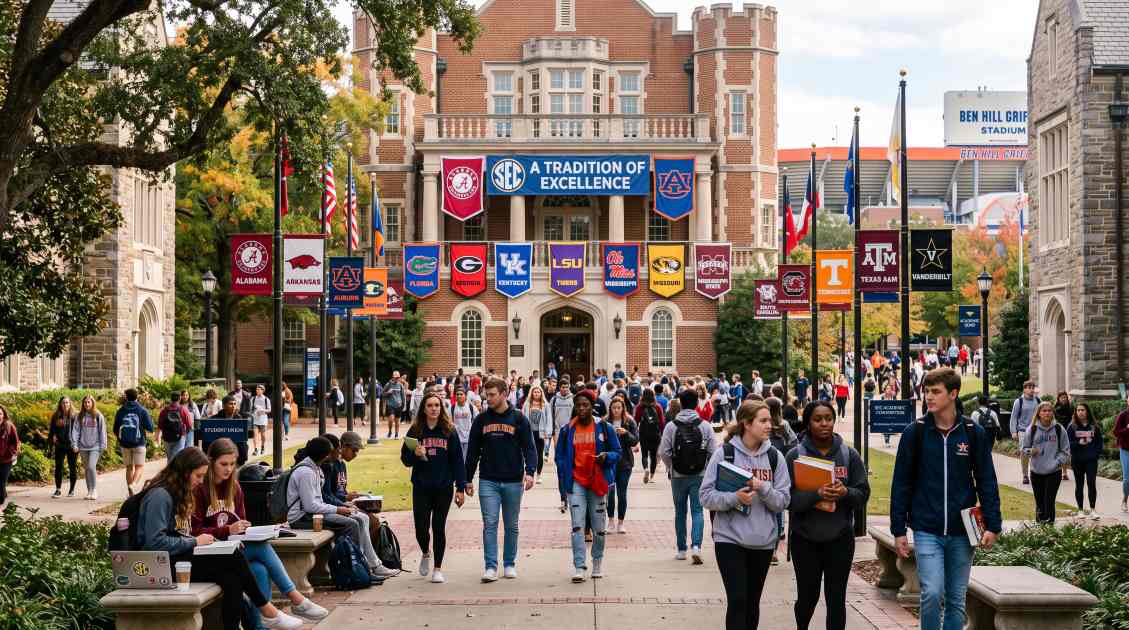
So why does a ranking sometimes miss the point? Because a single number cannot tell you which school fits your major, budget and goals. These SEC schools academic rankings compare the 16 members against each other using Waystone’s own methodology. It draws on federal College Scorecard data: what graduates owe versus what they earn, 10-year return on investment and graduation rate. Below, you’ll find the full ranking, admissions data, top majors, value comparisons and a step-by-step way to turn all of it into a college list.
- Vanderbilt (97.4), Florida (92.8) and UT Austin (84.4) lead Waystone’s 2026 SEC schools academic rankings, followed by Georgia (83.4) and Texas A&M (75.2).
- Every SEC school scores 94 or higher on Waystone’s national 10-year ROI scale, so the conference as a whole compares well against colleges nationwide.
- Vanderbilt is the hardest SEC school to get into, admitting 5.9% of applicants; Florida (24.2%) and UT Austin (26.6%) are the most selective publics.
- Florida has the lowest average net price in the conference at $6,541 a year [in-state], and it ranks first among SEC schools in business administration, finance, psychology and computer and information sciences.
- A school’s overall rank and its rank in your major often differ: Missouri ranks 6th overall but 2nd in journalism, and LSU ranks 15th overall but 3rd in subject-area teacher education.
SEC Schools Academic Rankings at a glance
Vanderbilt holds the top spot, and the gap between first and 16th is wider than the gap between most neighbors on the list. The table below shows every SEC member side by side. Acceptance rates, undergraduate enrollment and top majors come from the U. S. Department of Education’s College Scorecard, checked in September 2026. Top majors are the three fields with the most bachelor’s degrees awarded in the most recent year reported.
| Rank | School | State | Type | Waystone score | Acceptance rate | Undergrads | Top graduating majors |
|---|---|---|---|---|---|---|---|
| 1 | Vanderbilt University | TN | Private | 97.4 | 5.9% | 7,208 | Social sciences, economics, interdisciplinary studies |
| 2 | University of Florida | FL | Public | 92.8 | 24.2% | 35,629 | Psychology, biology, business administration |
| 3 | University of Texas at Austin | TX | Public | 84.4 | 26.6% | 42,855 | Biology, psychology, public relations and advertising |
| 4 | University of Georgia | GA | Public | 83.4 | 37.7% | 32,137 | Psychology, biology, finance |
| 5 | Texas A&M University | TX | Public | 75.2 | 57.4% | 59,615 | Biology, interdisciplinary studies, psychology |
| 6 | University of Missouri | MO | Public | 72.6 | 78.5% | 23,929 | Business, health sciences, journalism |
| 7 | University of Oklahoma | OK | Public | 72.4 | 76.6% | 22,734 | Marketing, human resources management, psychology |
| 8 | University of Tennessee, Knoxville | TN | Public | 70.5 | 41.6% | 30,418 | Business administration, experimental psychology, kinesiology |
| 9 | University of South Carolina | SC | Public | 69.2 | 60.2% | 29,820 | Finance, public health, experimental psychology |
| 10 | Auburn University | AL | Public | 68.3 | 45.9% | 26,816 | Business administration, finance, biology |
| 11 | University of Mississippi | MS | Public | 63.5 | 96.6% | 21,473 | Radio, TV and digital communication, nursing, accounting |
| 12 | University of Alabama | AL | Public | 63.1 | 76.7% | 33,227 | Finance, marketing, nursing |
| 13 | University of Kentucky | KY | Public | 63.0 | 92.9% | 24,763 | Business, nursing, marketing |
| 14 | University of Arkansas | AR | Public | 56.8 | 74.3% | 28,677 | Business administration, marketing, finance |
| 15 | Louisiana State University | LA | Public | 56.1 | 73.3% | 30,594 | Teacher education, biology, communication and media |
| 16 | Mississippi State University | MS | Public | 55.2 | 77.6% | 18,397 | Business administration, teacher education, kinesiology |
SEC Schools Academic Rankings
Waystone’s holistic methodology includes these inputs that build each school’s composite score:
- Debt payoff score: what a graduate owes, measured against what they earn, benchmarked nationally. That ratio is scored 0–100 against colleges nationwide. A lower ratio scores higher.
- 10-year ROI: This is the raw return on the cost of the degree, as a percentage, compared against what a full-time worker with only a high school diploma earns.
- 10-year ROI percentile: return on investment over a decade, ranked the same way against colleges nationwide.
- Institutional strength percentile: retention rate, student-faculty ratio, Pell-recipient completion equity and library investment per student, averaged from whichever of those four a school reports. That ratio is scored 0–100 against SEC schools. A higher ratio scores higher.
Important Note: ROI calculations use in-state tuition data for public institutions as that is the only data the Department of Education tracks. This means out of state students may have a lower ROI value for those Universities.
| Rank | School & program | What makes it distinctive | Score |
|---|---|---|---|
| 1 |
Vanderbilt University Nashville, TN · Private |
Every undergraduate completes Immersion Vanderbilt, a required experiential-learning project. |
97.4
ⓘ
Vanderbilt University: score breakdown
|
| 2 |
University of Florida Gainesville, FL · Public |
Lowest average net price in the SEC, plus AI coursework offered across all 16 colleges. |
92.8
ⓘ
University of Florida: score breakdown
|
| 3 |
University of Texas at Austin Austin, TX · Public |
New degrees pairing computer science with neuroscience, linguistics and history. |
84.4
ⓘ
University of Texas at Austin: score breakdown
|
| 4 |
University of Georgia Athens, GA · Public |
The only undergraduate cognitive science degree in the University System of Georgia. |
83.4
ⓘ
University of Georgia: score breakdown
|
| 5 |
Texas A&M University College Station, TX · Public |
More than 140 undergraduate degrees, plus combined bachelor’s-to-graduate pathways. |
75.2
ⓘ
Texas A&M University: score breakdown
|
| 6 |
University of Missouri Columbia, MO · Public |
Home of the world’s first journalism school. |
72.6
ⓘ
University of Missouri: score breakdown
|
| 7 |
University of Oklahoma Norman, OK · Public |
The largest meteorology program in the nation, housed in the National Weather Center. |
72.4
ⓘ
University of Oklahoma: score breakdown
|
| 8 |
University of Tennessee, Knoxville Knoxville, TN · Public |
A College of Emerging and Collaborative Studies built around AI, data science and custom degrees. |
70.5
ⓘ
University of Tennessee, Knoxville: score breakdown
|
| 9 |
University of South Carolina Columbia, SC · Public |
South Carolina’s only undergraduate aerospace engineering program. |
69.2
ⓘ
University of South Carolina: score breakdown
|
| 10 |
Auburn University Auburn, AL · Public |
Applied professional pathways in architecture, software engineering and supply chain management. |
68.3
ⓘ
Auburn University: score breakdown
|
| 11 |
University of Mississippi Oxford, MS · Public |
A flexible Bachelor of University Studies for returning students with prior credit. |
63.5
ⓘ
University of Mississippi: score breakdown
|
| 12 |
University of Alabama Tuscaloosa, AL · Public |
More than 185 years of engineering education and a large Honors College. |
63.1
ⓘ
University of Alabama: score breakdown
|
| 13 |
University of Kentucky Lexington, KY · Public |
All six health science colleges, including medicine and pharmacy, on one campus. |
63.0
ⓘ
University of Kentucky: score breakdown
|
| 14 |
University of Arkansas Fayetteville, AR · Public |
Undergraduate research supported across all 10 colleges and schools. |
56.8
ⓘ
University of Arkansas: score breakdown
|
| 15 |
Louisiana State University Baton Rouge, LA · Public |
A dedicated College of the Coast & Environment alongside agriculture, design and engineering. |
56.1
ⓘ
Louisiana State University: score breakdown
|
| 16 |
Mississippi State University Starkville, MS · Public |
Raspet Flight Research Laboratory, where undergraduates work on full-scale and unmanned aircraft. |
55.2
ⓘ
Mississippi State University: score breakdown
|
What if you’re applying from out of state?
We reran this SEC Schools Academic Rankings with each public school’s nonresident tuition premium added to its average net price, and the top 11 schools held their spots. No school moved more than one place. What changes is the cost of getting there.
Based on College Scorecard tuition figures, four years of out-of-state tuition adds $132,880 at UT Austin, $107,880 at Texas A&M and $89,112 at Florida. That’s enough to turn Florida’s 10-year ROI from 80% to -59% and UT Austin’s from 15.9% to -56.6%. Vanderbilt doesn’t move at all, because a private university charges every student the same price. So read the ranking as a guide to which schools deliver strong outcomes, and your home state as the biggest factor in what those outcomes cost you. For a nonresident, the merit aid a school offers can shift the math as much as its place on this list.
Quick answers by goal
- Best overall: Vanderbilt (97.4), with Florida (92.8) the top public university in the SEC.
- Most selective: Vanderbilt admits 5.9% of applicants, with an approximate SAT middle range of 1500-1570. Florida (24.2%) and UT Austin (26.6%) are the most selective publics.
- Engineering: Florida ranks first among SEC schools in mechanical and civil engineering on Waystone’s major-level scores, UT Austin first in electrical engineering and Vanderbilt first in biomedical engineering.
- Business: Florida leads in undergraduate business administration and finance, with UT Austin and Georgia close behind in both.
- In-state value: Florida’s average net price of $6,541 is the lowest in the conference. Ole Miss ($13,314) and Georgia ($13,936) come next.
- Large-university opportunities: Texas A&M enrolls 59,615 undergraduates, the most in the SEC, and lists more than 140 undergraduate degrees.
Why some SEC schools show a negative ROI
A negative 10-year ROI does not mean a degree loses money over a career. The formula uses earnings six years after a student first enrolls, which is only about two years after a typical graduation. It then holds those early earnings flat for a decade, with no raises. It simply means it may take longer to see the ROI compared to other colleges.
This ranking does not measure teaching quality, honors programs or campus culture. It also treats each university as a whole, so a school’s rank says little about your specific major. That’s why the major section below scores each school’s program in a given field. Graduation and earnings figures describe past students, not your own chances. Use this list to narrow your search.
Best SEC schools by major
The best SEC school for your major is often not the best SEC school overall. The table below scores each school’s program in a specific field. Schools are ranked only against other SEC schools offering the same major.
| Academic area | Top SEC scores in the field | What to compare |
|---|---|---|
| Business administration | Florida 93.9, Georgia 84.5, UT Austin 82.5, Tennessee 78.3 | Specializations, recruiting, direct admission to the business college |
| Finance | Florida 88.5, UT Austin 87.9, Georgia 86.9, Oklahoma 79.4 | Investment clubs, banking recruiting, CFA-aligned coursework |
| Accounting | Florida 87.8, UT Austin 83.6, Georgia 81.6, Texas A&M 79.7 | CPA exam pass rates, 150-hour pathways, firm recruiting |
| Computer science | Florida 95.9, UT Austin 91.7, Vanderbilt 91.2 | Course access, AI and data options, class size |
| Mechanical engineering | Florida 85.9, Vanderbilt 76.8, UT Austin 63.8, Texas A&M 50.9 | ABET accreditation, co-ops, undergraduate research |
| Biomedical engineering | Vanderbilt 92.9, Florida 72.1, UT Austin 56.1 | Lab and clinical access, pre-med compatibility |
| Psychology and pre-med sciences | Psychology: Florida 93.5, Vanderbilt 89.8, Georgia 86.2. Biology: Florida 80.9, UT Austin 77.7 | Research labs, health-professions advising, hospital access |
| Nursing | Florida 55.4, Ole Miss 48.2, Tennessee 48.1 | Direct-entry vs. competitive admission, clinical placements, NCLEX pass rates |
| Journalism and communications | Journalism: Florida 93.7, Missouri 81.7, Georgia 79.2. PR: Florida 93.6, UT Austin 87.1 | Student media, portfolios, internships |
| Agriculture | Agricultural business: Florida 88.5, Georgia 80.0, Texas A&M 71.0 | Land-grant extension networks, facilities, research farms |
| Education | Florida 89.7, Georgia 79.9, LSU 63.6 (subject-area teaching) | State certification, field placements, job outcomes |
| Architecture | Florida 87.2, UT Austin 71.6, Texas A&M 51.2 | NAAB accreditation, portfolio requirements, studio culture |
Best SEC schools for different students
The right SEC school depends on what kind of student you are and what you want from college. These pairings use the data above.
- Most selective academic environment: Vanderbilt, then Florida and UT Austin.
- Large flagship experience: Texas A&M, UT Austin and Florida, each with more than 35,000 undergraduates.
- Private-university setting: Vanderbilt is the SEC’s only private member.
- Honors-college opportunities: Alabama’s Honors College pairs small seminars with a large campus. Ask every public school on your list about its honors program.
- In-state students watching cost: Florida, Georgia and Ole Miss have the lowest average net prices among the publics.
- Undergraduate research: Vanderbilt requires an immersion project, and Arkansas supports research across all 10 colleges.
- Students who know their major first: use the major table above, not the overall rank.
Location matters too. Austin, Nashville, Baton Rouge and Columbia, S. C., put students in state capitals or large metro areas with bigger internship markets. Meanwhile, Auburn, Athens, Oxford, Starkville and College Station offer a classic college-town setting.
Not sure which environment or major fits you? Build your student's profile with a Waystone membership to get a full analysis that sorts schools into reach, good fit and safety based on GPA, state, intended major and cost.
Hardest SEC schools to get into: selectivity compared
Vanderbilt is the hardest SEC school to get into by a wide margin, followed by Florida and UT Austin. But selectivity and academic quality are not the same thing. A low acceptance rate reflects demand, application volume and class size. It does not tell you on its own which school is stronger or a better fit.
| School | Acceptance rate | Approx. SAT range | ACT range | Graduation rate | First-year retention |
|---|---|---|---|---|---|
| Vanderbilt | 5.9% | 1500-1570 | 34-35 | 93.5% | 96.3% |
| Florida | 24.2% | 1320-1480 | 29-33 | 91.1% | 97.7% |
| UT Austin | 26.6% | 1250-1510 | 27-33 | 88.9% | 96.7% |
| Georgia | 37.7% | 1270-1480 | 29-34 | 89.7% | 94.0% |
| Tennessee | 41.6% | 1200-1370 | 25-31 | 73.9% | 91.9% |
| Auburn | 45.9% | 1260-1390 | 26-31 | 82.0% | 94.8% |
| Texas A&M | 57.4% | 1150-1400 | 25-31 | 83.9% | 94.3% |
| South Carolina | 60.2% | 1180-1360 | 26-32 | 78.8% | 92.2% |
| LSU | 73.3% | 1180-1340 | 24-30 | 68.8% | 84.7% |
| Arkansas | 74.3% | 1030-1220 | 21-28 | 70.5% | 86.4% |
| Oklahoma | 76.6% | 1140-1330 | 23-29 | 75.3% | 90.0% |
| Alabama | 76.7% | 1170-1400 | 24-31 | 73.4% | 89.5% |
| Mississippi State | 77.6% | 1100-1350 | 21-29 | 66.7% | 82.5% |
| Missouri | 78.5% | 1150-1330 | 23-30 | 74.9% | 92.7% |
| Kentucky | 92.9% | 1070-1290 | 21-28 | 71.4% | 86.8% |
| Ole Miss | 96.6% | 1000-1200 | 21-29 | 71.7% | 87.2% |
Career outcomes and return on investment
Median debt at SEC schools runs from $14,000 at Vanderbilt to about $22,750 at Alabama, according to College Scorecard. Earnings vary far more by major than by school. At Florida, computer and information sciences graduates earn a median $126,268 four years after graduating, while journalism graduates earn $58,150. Compare graduation rates, debt and major-level earnings together, not one at a time.
Want to run those numbers yourself? Compare SEC programs on the College Finder to see median earnings, debt payoff and ROI at your family's income bracket.
How to use SEC academic rankings to build a college list
Start with where you want to end up, then let the rankings narrow the field. This seven-step process works whether you already know your major or you’re still exploring.
- Name a possible major or career direction. If you’re undecided, pick two or three possible fields.
- Find SEC schools with credible strength in that field. Use the major table above, not the overall rank.
- Compare your academic profile to each school’s admissions data. Look at acceptance rates and test ranges.
- Estimate net price before applying. Run each school’s net price calculator.
- Build a balanced list. Include likely, target and reach schools.
- Look past the numbers. Weigh campus culture, location, class size and outcomes.
- Visit, virtually or in person, then refine.
A worked example: biomedical engineering
Consider a student interested in biomedical engineering. Overall rank would point them to Vanderbilt and Florida, and the major data agrees: Vanderbilt scores 92.9 and Florida 72.1 in that field. But the next step is to compare accredited engineering pathways, lab and clinical research access, and proximity to health systems. That student should also check total cost and whether their profile makes each school a realistic target. For instance, Florida’s net price for a Florida resident makes it a very different decision than for a student from Ohio.
Frequently asked questions about SEC schools academic rankings
What is the best academic school in the SEC?
Vanderbilt University is the best academic school in the SEC on Waystone’s 2026 rankings, scoring 97.4 out of 100. It earns top marks on debt payoff and 10-year ROI, plus the highest institutional strength score in the conference. The University of Florida, at 92.8, is the highest-ranked public university in the conference.
Which SEC school is hardest to get into?
Vanderbilt is the hardest SEC school to get into, admitting 5.9% of applicants according to College Scorecard, with an approximate SAT middle range of 1500-1570. Among public universities, the University of Florida (24.2%) and UT Austin (26.6%) are the most selective, followed by the University of Georgia at 37.7%.
Are SEC schools good academically?
Yes. On Waystone’s national 10-year ROI scale, all 16 SEC schools score 94 or higher out of 100, placing every member near the top nationally for return on cost. Graduation rates range from 66.7% at Mississippi State to 93.5% at Vanderbilt, so academic outcomes still vary a lot within the conference.
What are the top public universities in the SEC?
The top public universities in the SEC on Waystone’s 2026 rankings are the University of Florida (92.8), UT Austin (84.4), the University of Georgia (83.4) and Texas A&M (75.2). Missouri follows at 72.6. All four leaders combine graduation rates above 83% with strong debt payoff and ROI scores.
Which SEC schools are best for engineering?
On Waystone’s major-level scores, Florida ranks first among SEC schools in mechanical and civil engineering, UT Austin first in electrical engineering and Vanderbilt first in biomedical engineering. Texas A&M ranks in the top four across all of those fields. South Carolina offers the state’s only undergraduate aerospace program.
Which SEC schools are best for business?
Florida leads SEC schools in undergraduate business administration (93.9), finance (88.5) and accounting (87.8) on Waystone’s major-level scores. UT Austin and Georgia follow closely in all three. These scores measure undergraduate outcomes, which can differ from a school’s MBA reputation.
Is Vanderbilt in the SEC?
Yes. Vanderbilt University in Nashville is a member of the SEC and its only private university. It is also the smallest school in the conference, with 7,208 undergraduates, and it ranks first in Waystone’s 2026 SEC schools academic rankings.
Is the University of Texas in the SEC?
Yes. The University of Texas at Austin and the University of Oklahoma officially joined the SEC on July 1, 2024, bringing the conference to 16 members. UT Austin ranks third in Waystone’s 2026 SEC rankings with a score of 84.4, and Oklahoma ranks seventh at 72.4.
Find your best-fit SEC school
SEC schools academic rankings can narrow your options, but they cannot tell you which university fits your major, budget and academic profile. Vanderbilt, Florida and UT Austin lead the conference overall. Yet schools like Missouri in journalism and LSU in teacher education rank far higher in their standout fields than their overall position suggests. And because every SEC school scores near the top nationally on return for cost, fit matters more than the gap between ranks.
So start with where you want to end up. Pick a direction, compare programs in that field, check net price and then build a balanced list. Want the full picture for your student? Get your personalized analysis, see plans and pricing to find the option that fits your timeline.