
Best Colleges for Data Science
The best colleges for data science in 2026 are led by Northwestern University, Dartmouth College and the University of Michigan-Ann Arbor. The ranking weighs debt payoff, ten-year return on investment, institutional strength and major concentration. Past that top three, the full list runs 20 schools deep across 14 states, from large research universities to small liberal arts colleges with a named data-science track.
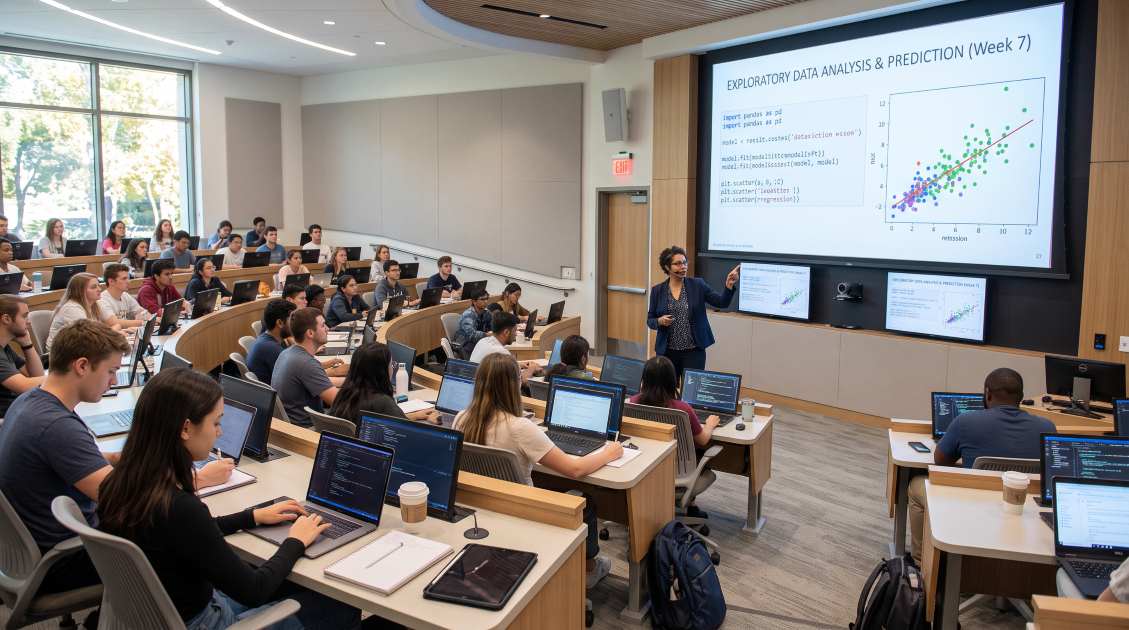
Data science remains one of the fastest-growing fields for a new graduate to enter. The U.S. Bureau of Labor Statistics projects 33.5% employment growth for data scientists from 2024 to 2034, with a median annual wage of $112,590 as of May 2024, far outpacing most occupations. But a strong undergraduate program trains for more than a job title. It builds statistics and programming skill together with the judgment to frame a real question, clean messy data, evaluate uncertainty, and explain a finding to someone without a technical background. That combination, not a syllabus full of tool names, separates a program built to produce a data scientist from one that just added the label to an existing computer science track
This guide not only covers the best colleges for data science but also walks through what data science coursework demands, how to test your own fit for it before you build a college list around it, what to do in high school right now if it interests you, and how to evaluate a specific program instead of trusting its name alone.
Key Takeaways
- Northwestern University ranks #1 among the best colleges for data science. Its composite score of 95.8 comes from top-tier debt payoff, ROI and institutional strength, backed by a required ethics course and a named capstone few peer programs match.
- Data science rewards students who like statistics and ambiguous problems, not just students who like coding. The two skill sets overlap, but they aren’t the same thing.
- A program’s name, Data Science, Data Analytics, or Computational Modeling, can hide very different course requirements, so check the curriculum itself before you apply.
- U.S. Bureau of Labor Statistics projects 33.5% employment growth for data scientists from 2024 to 2034, but the education bar varies sharply by specific role.
How we ranked the best colleges for data science
This ranking uses Waystone’s holistic methodology, not a single financial number and not a reputation survey. Four inputs build each school’s composite score:
- Debt payoff score: what a graduate owes, measured against what they earn, benchmarked nationally against every other school offering the same major.
- 10-year ROI percentile: return on investment over a decade, ranked the same way against national peers in the major.
- Institutional strength percentile: retention rate, student-faculty ratio, Pell-recipient completion equity and library investment per student, averaged from whichever of those four a school reports. This measure is institution-wide, not specific to the data science program itself.
- Major concentration percentile: how large a share of the school’s graduates completed this specific major.
If you want to see how your own profile lines up against a specific school here, see how Waystone’s analysis works before you narrow your own list.
Top 20 Best Colleges for Data Science
Click the info icon next to any score to see the four inputs behind it. For the full data sources and calculations behind each input, see Waystone’s methodology
| Rank | School & program | What makes it distinctive | Score |
|---|---|---|---|
| 1 | Northwestern University B.A. or B.S. in Data Science | Requires a three-course R or Python sequence, named core courses in data structures and information management, a required ethics elective, and a capstone, the Data Science Project (STAT 390). | 95.8 ⓘ Northwestern: score breakdown
|
| 2 | Dartmouth College Undergraduate data-science pathway, no standalone B.S. | No standalone major. DIFUSE, an NSF-funded $2.8 million initiative, embeds data-science modules directly into existing STEM and social-science courses instead of building one dedicated major. | 92.6 ⓘ Dartmouth: score breakdown
|
| 3 | University of Michigan-Ann Arbor B.S. in Data Science | The capstone can be completed through a cross-departmental Multidisciplinary Design Project with its own design-review report and expo poster, or through a faculty-supervised internship-as-capstone (STATS 489). | 90.3 ⓘ Michigan: score breakdown
|
| 4 | Columbia University Data Science major (Computer Science and Statistics) | Runs a standalone 18-course interdepartmental Data Science major, jointly administered by the Computer Science and Statistics departments and open to Columbia College and General Studies students alike. | 88.6 ⓘ Columbia: score breakdown
|
| 5 | William & Mary B.S. in Data Science | Offers a 36-credit B.S. completable in four to five semesters, split into four named tracks: Artificial Intelligence, Data Applications, Algorithms, and Spatial Data Analytics, plus a separate 18-credit minor. | 87.5 ⓘ William & Mary: score breakdown
|
| 6 | Smith College B.A. in Statistical & Data Sciences | The required capstone (SDS 410) is a team project sponsored by an outside academic, government or industry partner, and the “data-in-context” requirement draws from 8 named courses like Data Journalism and Data Ethnography. | 87.1 ⓘ Smith: score breakdown
|
| 7 | Case Western Reserve University B.S. in Data Science and Analytics | Holds ABET accreditation from the Computing Accreditation Commission under its specific Program Criteria for Data Science, Data Analytics and Similarly Named Computing Programs; a separate university-wide minor adds eight named domain concentrations, from energy to finance. | 84.9 ⓘ Case Western: score breakdown
|
| 8 | Worcester Polytechnic Institute B.S. in Data Science | The BS/MS pathway earns both degrees in as few as 5 years by double-counting up to 12 credits toward the MS, and the BS capstone is a year-long project solving a live sponsor’s problem at one of WPI’s 50-plus global project centers. | 83.9 ⓘ WPI: score breakdown
|
| 9 | Southern Methodist University B.S. in Data Science | The 36-credit major “cannot be the first major declared by a student,” per SMU’s own catalog. It must be paired with a second major in business, humanities, social science, engineering or another field. | 83.8 ⓘ SMU: score breakdown
|
| 10 | University of Wisconsin-Madison B.A. or B.S. in Data Science | WISCURDS, launched in 2025 by UW’s Data Science Institute, runs two undergraduate research tracks: small group projects with faculty and industry mentors, or one-on-one individual faculty mentorship on open-ended real projects. | 81.9 ⓘ UW-Madison: score breakdown
|
| 11 | Drexel University B.S. in Data Science | Requires a minor, typically business or the sciences, and offers exactly two co-op formats: a 4-year track with one 6-month co-op, or a 5-year track with three separate co-ops. | 81.6 ⓘ Drexel: score breakdown
|
| 12 | Virginia Polytechnic Institute and State University B.S. in Computational Modeling and Data Analytics | Splits into six named degree options, Standard, Biological Sciences, Cryptography and Cybersecurity, Economics, Geosciences, and Physics, each adding its own specialized elective sequence on top of the shared core. | 79.9 ⓘ Virginia Tech: score breakdown
|
| 13 | Florida Polytechnic University B.S. in Data Science | The two-course senior capstone is industry-sponsored: cross-disciplinary teams solve a live sponsor problem, from supply-chain optimization to hospital-readmission risk, backed by a mandatory internship and named elective tracks in Big Data Analytics, Econometrics or Autonomous Systems. | 79.9 ⓘ Florida Poly: score breakdown
|
| 14 | Denison University B.A. or B.S. in Data Analytics | A required summer internship or research project (DA 030), approved by the Data Analytics Program Committee, feeds directly into the required senior capstone seminar (DA 401). | 78.6 ⓘ Denison: score breakdown
|
| 15 | Mount Holyoke College B.A. in Data Science | The Data Analytics and Society Nexus is an 18-credit interdisciplinary track requiring statistics, computer science and applied-discipline coursework, a 300-level capstone, and a required internship or research experience. | 78.3 ⓘ Mount Holyoke: score breakdown
|
| 16 | Rose-Hulman Institute of Technology Data Science, second major only | Offered only as a second major: the program requires 72 credit hours, 36 fundamental, 20 advanced, 16 elective, plus a senior capstone project, on top of a student’s primary degree. | 76.2 ⓘ Rose-Hulman: score breakdown
|
| 17 | Saint Mary’s College of California B.S. in Data Science | Housed in the Business Analytics and Data Science Department within the School of Economics and Business Administration, with a required capstone (DATA 496) and a separate internship course (DATA 495). | 75.5 ⓘ Saint Mary’s: score breakdown
|
| 18 | Saint Louis University B.S. in Data Science | Runs four semesters of structured practicum and capstone work: two practicum courses across the first two years, then a two-course senior capstone sequence spanning fall and spring. | 75.4 ⓘ Saint Louis University: score breakdown
|
| 19 | Pennsylvania State University-Main Campus B.S. in Data Sciences | Splits into three named, college-based options, Applied Data Sciences through the College of IST, Computational Data Sciences through Engineering, and Statistical Modeling Data Sciences through the Eberly College of Science, after two years of shared core coursework. | 74.5 ⓘ Penn State: score breakdown
|
| 20 | University of Texas at Dallas B.S. in Data Science | Described on its own department page as “a new joint degree program” between Mathematical Sciences and Computer Science, with a required capstone project built into the major. | 74.2 ⓘ UT Dallas: score breakdown
|
What about MIT, Stanford or Carnegie Mellon?
MIT, Stanford and Carnegie Mellon don’t appear in this top 20, and the reason isn’t the same for all three. MIT has no standalone major named “Data Science.” Its closest option is Course 6-14, a joint Computer Science, Economics and Data Science major run by MIT’s Electrical Engineering and Computer Science department and its Economics department, plus a separate Statistics and Data Science minor. That structural gap alone can keep a school out of a major-specific ranking like this one, the same reason Dartmouth appears here without a standalone major of its own.
Stanford and Carnegie Mellon are different cases. Stanford runs a real standalone Data Science program with both a B.S. and a B.A. track, sponsored jointly by its Statistics, Mathematics, Computer Science and Management Science and Engineering departments. Carnegie Mellon’s Department of Statistics and Data Science offers five separate undergraduate majors under that name. Neither school lacks a program, so their absence here reflects their scores on debt payoff, ROI, institutional strength and major concentration.
Research-focused vs. industry-facing vs. second-major structures
The 20 programs on this list split into three structural patterns, and knowing which one a school follows tells you more than its rank alone. Some are built around undergraduate research access. Others are built around a mandatory outside placement. Others fold data science into a second, named field by design.
Research-focused programs
Dartmouth’s DIFUSE initiative, UW-Madison’s WISCURDS, Michigan’s faculty-supervised internship-as-capstone option, and Mount Holyoke’s Data Analytics and Society Nexus all give undergraduates direct access to faculty-mentored inquiry, not just coursework. This structure fits a student who wants a research portfolio for graduate school or a specialized industry role before senior year even starts.
Industry-facing programs
WPI’s year-long capstone solves a live sponsor’s problem at one of its global project centers, and Florida Poly’s two-course capstone runs the same way with its own industry sponsors. Drexel’s co-op formats, Denison’s required internship, Saint Mary’s internship course, and Saint Louis University’s four semesters of practicum work all point toward the same outcome: proof of work with an outside employer before graduation, not just a transcript.
Second-major and domain-pairing structures
SMU and Rose-Hulman make data science a mandatory second major by design, not an option. Case Western, Virginia Tech, William & Mary and Penn State take a softer version of the same idea, building named domain tracks or a paired minor directly into the major so a graduate leaves with technical training plus a stated application field.</p>
Northwestern, Columbia, Smith and UT Dallas don’t lean hard into any one of these three patterns. They run a standalone core curriculum instead, betting that a rigorous, self-contained major serves a broader range of students than a structure built around one specific outcome. None of the three patterns is the stronger choice by default. The right one depends on whether you already know your target industry, want a research credential, or are still deciding what to pair the major with.
Data science vs. related majors
Data science is the discipline of turning raw, often messy data into a decision, combining statistics, programming and communication into one skill set. That definition sounds close to three other majors, computer science, statistics and data analytics, and the overlap is real. What separates them is which part of that process each major trains you to do best.
| Major | Core question it answers | Coursework emphasis | Best fit for students who… |
|---|---|---|---|
| Data Science | What can we learn or predict from this dataset? | Statistics, programming, databases, visualization, machine learning | Want the full pipeline: cleaning data, modeling it, and explaining the result |
| Computer Science | How do we build reliable software and systems? | Algorithms, software engineering, systems, theory | Are most excited by building the tool, not analyzing the output |
| Statistics | What conclusions are justified by this data? | Probability, inference, experimental design, theory | Like proving why a result is or isn’t reliable |
| Data Analytics | How should this organization act on its data? | Dashboards, business framing, applied statistics, communication | Want a business or policy angle more than a technical one |
| AI / Machine Learning | How can a system learn patterns or generate outputs on its own? | Machine learning, optimization, neural networks, algorithms | Want to build or research the learning systems themselves, not just use them |
Choose data science for an integrated curriculum that treats the full data lifecycle, sourcing, managing, analyzing, modeling and communicating data, as the central subject.
How AI fits into a data science degree
AI is increasingly part of a data science degree, but it never substitutes for the underlying foundation. Data science supplies the process that makes an AI system useful: defining the problem, collecting and cleaning data, choosing variables, measuring performance, and communicating where a model’s limits are.
A well-designed undergraduate data science curriculum typically includes programming (often Python, sometimes R), databases, probability and statistical modeling, linear algebra and calculus, supervised and unsupervised machine learning, data visualization, and a capstone using imperfect real-world data. So check whether a program offers more than one introductory machine-learning course before assuming “AI” appears meaningfully in the curriculum. Northwestern requires Advanced Machine Learning specifically, and Virginia Tech’s Cryptography and Cybersecurity track layers an advanced sequence on top of the shared core.
The distinction that matters most: a data scientist typically uses AI models to solve a decision problem, while a machine-learning engineer builds, deploys and maintains that model in a production system. That second path generally demands stronger software engineering, algorithms and systems preparation than a standard data science major provides on its own.
Career paths and what prepares you for them
A data science degree can lead to analytical and technical work across technology, health care, finance, consulting and government, and entry-level graduates often start in an analyst role before moving into a “data scientist” title.
| Career direction | Typical work | Helpful undergraduate preparation |
|---|---|---|
| Data analyst / BI analyst | Queries data, builds dashboards, explains trends to stakeholders | SQL, Python or R, visualization, business communication |
| Data scientist | Develops models, runs experiments, evaluates uncertainty | Statistics, machine learning, programming, a capstone |
| Product analyst | Measures product use, retention and experimentation outcomes | SQL, A/B testing, statistics, product sense |
| Data engineer | Builds data pipelines and reliable data infrastructure | Databases, distributed systems, software engineering |
| Machine-learning engineer | Deploys and maintains models in production systems | Strong computer science, algorithms, software engineering |
But a bachelor’s degree doesn’t guarantee entry into every one of these paths equally. O*NET’s employer survey data shows 48% of respondents require only a bachelor’s degree for a data scientist role, while 44% require a master’s, so the more research-heavy or specialized roles often reward graduate study on top of a strong undergraduate foundation.
Frequently asked questions
What are the best colleges for data science?
The best colleges for data science, ranked by debt payoff, 10-year ROI, institutional strength and major concentration, are led by Northwestern University, Dartmouth College and the University of Michigan-Ann Arbor. The full ranked list of 20 programs above shows the same four inputs, plus a specific verified distinctive fact, for every school, so you can compare well beyond just the top three.
Is data science a good major?
Data science is a good major for a student who genuinely likes statistics, tolerates ambiguous problems, and wants to communicate findings, not just build models in isolation. It’s a weaker choice if you’re drawn only to the salary data, since the coursework itself demands real interest in the material to get through four years of it.
What’s the difference between data science and computer science?
A data science degree centers on the full data lifecycle, sourcing, managing, analyzing, modeling and communicating data, while a computer science degree centers on designing reliable computational systems and software. A data science graduate is more likely to become a data analyst or junior data scientist, while a computer science graduate is more likely to become a software or backend engineer, though the two fields overlap heavily in required coursework.
Should I major in data science or computer science?
Choose data science if you’re equally interested in statistics and programming and want the full pipeline from raw data to a decision. Choose computer science instead if building software and systems excites you more than analyzing the output, since you can always add data science coursework or a minor later.
Do I need to know how to code before I major in data science?
No, most data science programs teach programming from the ground up, so you don’t need prior coding experience to apply. That said, trying a free introductory Python course before you commit is a low-cost way to confirm you’ll enjoy the programming side of the major.
Can I switch into data science if I start college undecided?
Yes, in most cases, especially if you complete the math prerequisites (calculus and an introductory statistics course) during your first year. Switching becomes harder the longer you wait, since data science programs often require specific courses in a set sequence starting freshman year.
Use the ranking to build your list, and use the evaluation checklist to test any specific school on it, standalone major or track, required capstone or elective, real research access or none. Then run your own math, activities and course rigor against the programs that make your shortlist, since a composite score never accounts for your specific GPA, state residency or career target.
The Waystone Analysis shows exactly how a student profile lines up with target colleges. Start creating a profile for free, upgrade at anytime.