
Best Colleges Computer Science
The best colleges computer science students should target in 2026 are led by MIT, Stanford and Williams College, based on Waystone's own scoring. All three post a debt payoff score and a 10-year ROI in the 100th percentile nationally among computer science programs. This list ranks 20 programs on financial payoff, return on investment, institutional strength and major concentration.
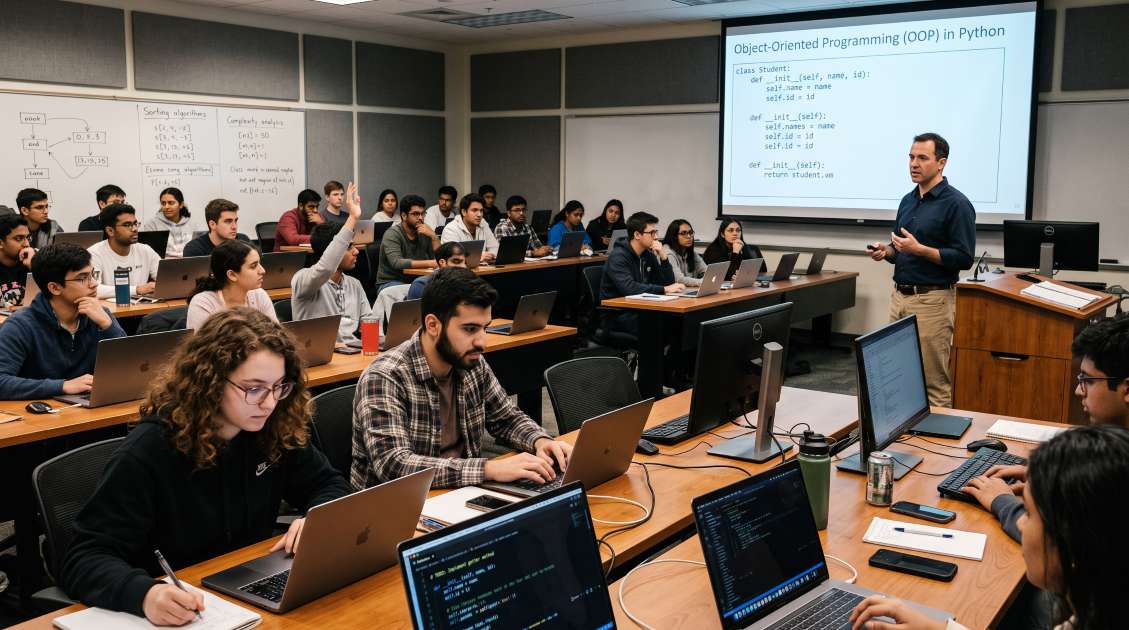
Search “best colleges computer science” and most results hand back the same five or six household names, just shuffled into a different order. None of them explain why those names are there. That’s a real gap, because computer science is one of the few majors where the financial stakes of picking the wrong program are easy to measure. Debt load, real earnings and how specialized a school actually is in the major all vary more than most applicants expect.
This guide breaks down how Waystone scores the best colleges of computer science. It walks through the full ranked list. Then it covers what actually differs between a computer science B.S. and a B.A., how selective these majors really are, and what a computer science degree pays off in practice.
Key Takeaways
- MIT tops Waystone’s best colleges computer science ranking at 97.8 out of 100. Stanford follows closely at 97.0, then Williams College at 96.5.
- Several strong public options score in the top half too. UNC Chapel Hill, University of Washington-Seattle and UC San Diego all land there at far lower sticker prices.
- A computer science B.S. and B.A. from the same school can carry real differences in math requirements and specialization, not just a label.
- Computer science graduates from the Class of 2026 average a starting salary of $81,535. That’s the highest of any major tracked by the National Association of Colleges and Employers.
How Waystone ranks the best colleges computer science programs
This best colleges computer science ranking uses Waystone’s holistic methodology, not a single financial number. Four inputs feed the composite score for every eligible program: a debt payoff score, 10-year ROI, institutional strength and major concentration. That’s the share of a school’s graduates who actually complete the computer science major.
A program with a strong debt-to-earnings ratio and solid graduate outcomes can outscore a more selective school that saddles students with more relative debt. As a result, a few less-famous names land in the middle of this list ahead of schools with far bigger name recognition. CUNY Queens College and UW Bothell both make that case.
Every input here is a percentile rank against other schools offering computer science nationally. So none of it is a raw dollar figure or a raw share of graduates. The 20 schools below are drawn from a larger eligible pool of institutions with complete data on all four inputs.
Want to see how a program outside the national top 20 compares on these same inputs? The College Finder covers every school that offers computer science, including ones that don’t specialize in it as heavily as the schools below. It’s free to search. You can sort by completion rate, median earnings and debt payoff score for any program, not just the top 20.
The best colleges computer science has to offer in 2026
Below is the full ranked list. Click the ⓘ icon next to any score to see that school’s full breakdown across all four inputs.
| Rank | School & program | State | What makes it distinctive | Score |
|---|---|---|---|---|
| 1 |
MIT B.S. in Computer Science and Engineering (Course 6-3) |
Massachusetts | One of MIT’s single most popular majors outright: roughly a fifth of every graduating class declares 6-3 specifically, not counting its adjacent Course 6 majors |
97.8
ⓘ
MIT: score breakdown
|
| 2 |
Stanford University B.S. in Computer Science |
California | CS106A, the intro course, grew into the single largest class on Stanford’s campus, part of a curriculum overhaul that made computer science the university’s most popular major |
97.0
ⓘ
Stanford University: score breakdown
|
| 3 |
Williams College B.A. in Computer Science |
Massachusetts | One of the few computer science departments offering Williams’ distinctive tutorial format: two students meet weekly with a professor for an hour of direct argument and critique |
96.5
ⓘ
Williams College: score breakdown
|
| 4 |
Carnegie Mellon University B.S. in Computer Science |
Pennsylvania | Launched the nation’s first standalone bachelor’s degree in artificial intelligence in 2018, ahead of every other school on this list |
91.2
ⓘ
Carnegie Mellon University: score breakdown
|
| 5 |
Vanderbilt University B.A. in Computer Science |
Tennessee | Backed by a $25 million gift, its parent college is the first new college Vanderbilt has created since 1981 |
89.4
ⓘ
Vanderbilt University: score breakdown
|
| 6 |
UC Berkeley B.A. in Computer Science |
California | Bachelor’s graduates in CS/EECS roughly tripled in a decade, from about 400 a year to about 1,400, prompting a new capacity-driven declaration policy for incoming students |
89.3
ⓘ
UC Berkeley: score breakdown
|
| 7 |
Brown University B.A. in Computer Science |
Rhode Island | Brown’s Open Curriculum imposes zero required courses outside the concentration itself, just 30 courses total plus a writing requirement to graduate |
89.1
ⓘ
Brown University: score breakdown
|
| 8 |
Columbia University B.A. in Computer Science |
New York | Housed in a school founded in 1863 as the country’s first school of mines; its patents now generate more than $100 million a year for the university |
87.7
ⓘ
Columbia University: score breakdown
|
| 9 |
Cornell University B.A. or B.S. in Computer Science |
New York | One of the first computer science departments in the country, organized in 1965, whose faculty also anchor Cornell Tech’s applied programs on Roosevelt Island in Manhattan |
87.1
ⓘ
Cornell University: score breakdown
|
| 10 |
UNC Chapel Hill B.S. in Computer Science |
North Carolina | Founded in 1964 by Turing Award winner Frederick Brooks Jr., making it the second free-standing computer science department in the country |
86.6
ⓘ
UNC Chapel Hill: score breakdown
|
| 11 |
University of Washington-Seattle B.S. in Computer Science |
Washington | Named for Paul Allen in 2017, on the same campus where Allen and a teenage Bill Gates first taught themselves to program on university computers |
86.4
ⓘ
University of Washington-Seattle: score breakdown
|
| 12 |
Washington University in St. Louis B.S. in Computer Science |
Missouri | One of the first independent computer science departments in the world, spun out from applied mathematics in 1974 after WashU awarded one of the nation’s first computer science doctorates in 1965 |
85.9
ⓘ
Washington University in St. Louis: score breakdown
|
| 13 |
UC San Diego B.S. in Computer Science |
California | The largest engineering department in the entire UC system; its UCSD Pascal system in the 1970s helped bring microprocessors into everyday computers |
85.1
ⓘ
UC San Diego: score breakdown
|
| 14 |
Duke University B.S. or B.A. in Computer Science |
North Carolina | Grew from four founding faculty in 1973 to become Duke’s single largest major outright, with 423 graduates in 2023 alone |
84.9
ⓘ
Duke University: score breakdown
|
| 15 |
CUNY Queens College B.S. in Computer Science |
New York | Alumni Russell Artzt and Charles Wang went on to co-found Computer Associates, once one of the world’s largest independent software companies |
84.0
ⓘ
CUNY Queens College: score breakdown
|
| 16 |
Dartmouth College B.A. in Computer Science |
New Hampshire | The birthplace of BASIC, the programming language two Dartmouth math professors invented in 1964 specifically to make coding accessible to non-specialists |
83.9
ⓘ
Dartmouth College: score breakdown
|
| 17 |
CUNY Hunter College B.A. in Computer Science |
New York | Built in 1981 by pulling faculty directly out of Hunter’s own math department, with a Women in Computer Science initiative in place from its earliest years |
83.4
ⓘ
CUNY Hunter College: score breakdown
|
| 18 |
University of Washington-Bothell B.S. in Computer Science & Software Engineering |
Washington | Every senior completes a 5-to-9-month capstone embedded with a real client company in the Puget Sound tech corridor, not a simulated project |
82.4
ⓘ
University of Washington-Bothell: score breakdown
|
| 19 |
University of Illinois Urbana-Champaign B.S. in Computer Science |
Illinois | Home to the 1952 ILLIAC I, the first computer ever built entirely by a university, and to the NCSA team that built Mosaic, the browser that became Netscape |
80.2
ⓘ
University of Illinois Urbana-Champaign: score breakdown
|
| 20 |
Harvey Mudd College B.S. in Computer Science |
California | Restructured its intro course into parallel tracks by experience level, a change credited with pushing women from 10% to over half of CS majors within a decade |
79.1
ⓘ
Harvey Mudd College: score breakdown
|
Two patterns stand out once you read the full best colleges of computer science list. First, several public options score in the top half at a fraction of the sticker price most private schools on this list. This list includes UNC Chapel Hill, University of Washington-Seattle, WashU and UC San Diego. Second, institutional strength, not payoff or ROI, is what actually separates the top five from the rest. MIT, Stanford and Williams all post a perfect or near-perfect payoff and ROI score. So the tiebreaker comes down to retention, faculty access and library investment instead.
Want to see how a specific school compares once you factor in your own state residency or income bracket? Search computer science on the College Finder. It pulls net price, completion rate and ROI at your family’s actual income level, free of charge and with no account required.
Computer science vs. adjacent majors and specialties: how the coursework actually splits
Four adjacent majors get confused with computer science constantly: data science, computer engineering, software engineering and information systems. Each one starts from the same rough set of intro courses, then splits hard. Picking the wrong one can mean four years building a skill set that doesn’t match the career you actually want.
| Major | Heaviest coursework in | Lightest on | Best fit if you want to |
|---|---|---|---|
| Computer science | Algorithms, data structures, systems, theory of computation | Circuits, statistics-heavy inference | Software engineering, research, a broad technical base |
| Data science | Statistics, probability, machine learning, data wrangling | Computer architecture, operating systems, compilers | Applied ML, analytics, working with existing models rather than building systems from scratch |
| Computer engineering | Circuits, digital logic, embedded systems, computer architecture | Deep algorithms and theory electives | Hardware, robotics, embedded systems, chip design |
| Software engineering | Software design, testing, team-based project work | Formal theory of computation, complexity | Building production software specifically, on a team, from day one |
| Information systems | Database management, business process, project management | Algorithms and low-level systems | The business and management side of technology, not engineering itself |
Two schools on this list draw the software-engineering line explicitly, not just informally. University of Washington-Bothell names its major Computer Science & Software Engineering. While Duke folds a dedicated software engineering and design concentration into its B.S., alongside separate concentrations in software systems, data science, and AI and machine learning.
How specialization tracks work inside computer science itself
Even within a single computer science major, the track a student picks shapes the degree as much as the school does. Stanford’s B.S. runs on eight named tracks: artificial intelligence, biocomputation, computer engineering, graphics, human-computer interaction, information, systems and theory, plus an unspecialized option. MIT’s Course 6 department goes further still. It offers entirely separate adjacent majors, not just tracks: AI and Decision Making, Computer Science and Molecular Biology, and Computer Science, Economics and Data Science, all alongside the core 6-3 major.
Vanderbilt’s new College of Connected Computing pairs its computer science major with data science and scientific computing under one roof. Harvey Mudd goes furthest of all twenty schools here. Its joint Computer Science and Climate major is built for students who want to point their technical training directly at climate research and adaptation work. None of that shows up in a composite score. It only shows up when you actually read a department’s course catalog.
What actually differs between a CS B.S. and a CS B.A.
A B.S. and a B.A. in computer science from the same school still aren’t interchangeable, either. The B.S. route is common at Cornell’s College of Engineering, WashU and UC San Diego. It typically requires more math and more required computer science credits, so it leaves less room for outside electives. The B.A. route, offered by schools like Brown, Williams and Cornell’s College of Arts & Sciences, still covers the core sequence. But it trades some of that math load for humanities or social science requirements instead. That structure suits a student who wants to double major, add a minor, or keep options open for law school or an MBA later.
ABET, the accrediting body that covers most engineering and computing degrees, typically accredits B.S.-level computing programs rather than a liberal-arts B.A. That’s a real structural difference worth asking a department about directly, not a formality to skip past.
Match the choice to where you’re headed, not to which option sounds more rigorous. A student aiming at graduate school in machine learning or a highly technical systems role usually gets more out of a B.S.’s deeper math sequence. A student who wants computer science alongside economics, design or public policy tends to get more mileage from a B.A.’s flexibility. Duke, Cornell and Columbia all let applicants weigh this directly, since each offers both degree types under one roof.
What separates a strong Computer Science program
Undergraduate research access
Real research experience, not just coursework, is what separates a strong program from a merely well-funded one. MIT’s Undergraduate Research Opportunities Program, or UROP, is the clearest example on this list. Ninety-three percent of MIT’s graduating seniors complete at least one UROP, and over 90% of EECS undergraduates specifically do the same. That’s close to a universal experience for MIT computer science students.
Most schools don’t publish a participation rate this specific, so ask directly. First, find out how many first- and second-year students, not just seniors, actually land a spot in a faculty lab. Then check whether that access is guaranteed or competitive. A program that can answer both questions with a real number is signaling something important.
Program capacity and class size
Large public programs admit big cohorts. UC Berkeley, UC San Diego and University of Washington-Seattle all fit that pattern, and students there can still compete for TA office hours and lab machine time in oversubscribed intro courses. That tradeoff comes with real advantages too, though: more course variety, bigger research groups, deeper alumni networks in tech hubs.
Smaller programs trade that scale for closer contact instead. Williams, Dartmouth and Harvey Mudd all run computer science departments built around small class sizes and direct faculty access from a student’s first semester. Neither model is better across the board. Ask a department how large its intro Computer Science sequence actually runs, and how quickly a student can get one-on-one time with a professor, not just a teaching assistant.
Research output, independent of financial return
Those are genuinely different questions. A student set on a research career or a Ph.D. afterward should also check CSRankings.org instead. It’s a metrics-based ranking that scores computer science departments purely on faculty publications at selective research venues, with no tuition or ROI figure involved at all. A school can score well on Waystone’s financial ranking and modestly on research output, or the reverse. Both outcomes are worth knowing before you commit to a specific track.
How selective are computer science majors, really
A computer science major’s acceptance rate is often tighter than the university’s overall admit rate. UC Berkeley, UC San Diego and University of Washington-Seattle all run a separate, selective process just to declare computer science, on top of the university’s general admission standard. UC Berkeley’s current guidance, for instance, notes a 3.0 minimum GPA and a competitive review to enter the L&S computer science major specifically.
That gap between a school’s overall selectivity and its computer science program’s selectivity can be important. A school that reads as a good fit, or even a safety, on paper can turn into a reach once its computer science major has its own admissions gate. The reverse happens too. UW Seattle’s Direct to Major pathway removes that later competitive step entirely for admitted first-years. That changes the math for anyone weighing UW against a school with a post-enrollment gate instead.
So before you add a school to your list because it made this best colleges computer science undergraduate ranking, check three things directly with the department. First, ask whether computer science is a direct-admit major or a secondary, competitive declaration. Next, ask what GPA or course-completion threshold that secondary declaration actually requires. Then ask how many students who intend to major in computer science end up admitted to it. Those three answers tell you more about your real odds than the university’s published overall acceptance rate ever will.
Course rigor in math and science also carries weight and could help or hurt your chances. Calculus, ideally with a second math course beyond it, along with AP Computer Science or an equivalent, signals readiness for a computer science curriculum’s first-year pace. That coursework matters more for this major specifically than for many others.
Is computer science worth the major-specific admissions hurdle
Yes, on the numbers so far. Computer science graduates from the Class of 2026 average a starting salary of $81,535, the highest of any major category tracked. That figure comes from the National Association of Colleges and Employers. This sits above engineering’s $81,198 average, and well above the $74,184 average for math and science majors overall. The broader software developer occupation, which most computer science graduates enter, carries a median annual wage of $135,980 as of May 2025. The Bureau of Labor Statistics projects employment there will grow 10% from 2025 to 2035.
That said, AI is already reshaping which entry-level computer science jobs exist, and which ones get automated first. A degree from a school on this best colleges computer science list doesn’t insulate a graduate from that shift by itself. What tends to matter more is whether a student built real systems, research or internship experience during the degree, not just coursework. Waystone’s guide on whether a degree is still worth it in the age of AI breaks down which majors, and which specific skills, are holding up best.
Still deciding between computer science and an adjacent field, like data science, computer engineering or information systems? The underlying question isn’t which major sounds most impressive on an application. Instead, it’s which one actually matches the problems you want to work on after graduation. Waystone’s guide on whether your major matters more than your school walks through that decision in more detail. It applies just as directly to computer science as it does to any other field.
Build a plan that starts from your actual profile, not a ranking position. Build your profile and get a full analysis that checks your GPA, activities and course rigor against your specific target schools, computer science included.
Frequently asked questions
What is the best college for computer science?
Waystone’s own ranking has a clear order at the top. MIT scores highest at 97.8 out of 100, then Stanford at 97.0 and Williams College at 96.5. All three post a perfect or near-perfect payoff and ROI percentile. So their institutional strength scores end up separating them, and MIT and Stanford still edge out Williams there. The right answer for you still depends on whether you want a large research-engineering environment or a smaller liberal-arts setting.
What’s the difference between a computer science B.S. and a computer science B.A.?
A B.S. usually requires more math, lab science and required computer science credits, leaving less room for outside electives. A B.A. covers the same core computer science sequence, but trades some of that math and science load for broader humanities or social science requirements. Neither is stronger by default. The right choice depends on whether you want maximum flexibility, or a deeper technical sequence instead.
Is a computer science major hard to get into?
It depends on the specific program, not just the university’s overall acceptance rate. Several schools here, including UC Berkeley, UC San Diego and University of Washington-Seattle, require a separate, competitive declaration into computer science after admission or enrollment. So ask a department directly whether its major is direct-admit or a later competitive gate, before assuming your odds match the school’s published overall rate.
Do I need to go to one of the best colleges computer science schools to get a good tech job?
No. Strong outcomes in computer science come from a mix of coursework, real projects and internship experience, not from attending one specific school on any ranking. A student who builds a genuine portfolio of systems or research work at a solid, less-famous program often competes just as well as one from a top-20 name. That said, schools higher on this list tend to have stronger average debt-to-earnings outcomes, which is worth weighing against cost.
Should I pick a school based on its computer science ranking or its overall prestige?
Match the ranking to the question you’re actually asking. A school’s overall prestige ranking mostly reflects name recognition and general selectivity. This best colleges computer science list instead measures financial payoff, ROI and institutional strength for the major specifically. That can diverge sharply from a school’s overall reputation, in either direction.
How is a computer science degree’s payoff actually calculated?
Waystone’s debt payoff score compares what a computer science graduate typically owes against what they earn afterward, benchmarked nationally against every other school offering the major. The 10-year ROI figure works the same way, measuring return against cost over a decade. Both are percentile ranks, not raw dollar amounts. That lets you compare a $70,000-a-year private school against a $12,000-a-year public one on equal footing.
Where to go from here
The best colleges computer science students should actually consider aren’t necessarily the five names everyone already recognizes. MIT, Stanford and Williams top Waystone’s ranking on real financial and institutional data, not reputation alone. But strong public options land in the top half too, often at a fraction of the cost. So don’t let sticker price rule a school out early.
Start by checking whether your target school’s computer science major has its own admissions gate, separate from general admission. Then weigh a B.S. against a B.A. based on how much flexibility you actually want outside the major. From there, match your own GPA, state residency and activity profile against these specific programs, not against a ranking position.