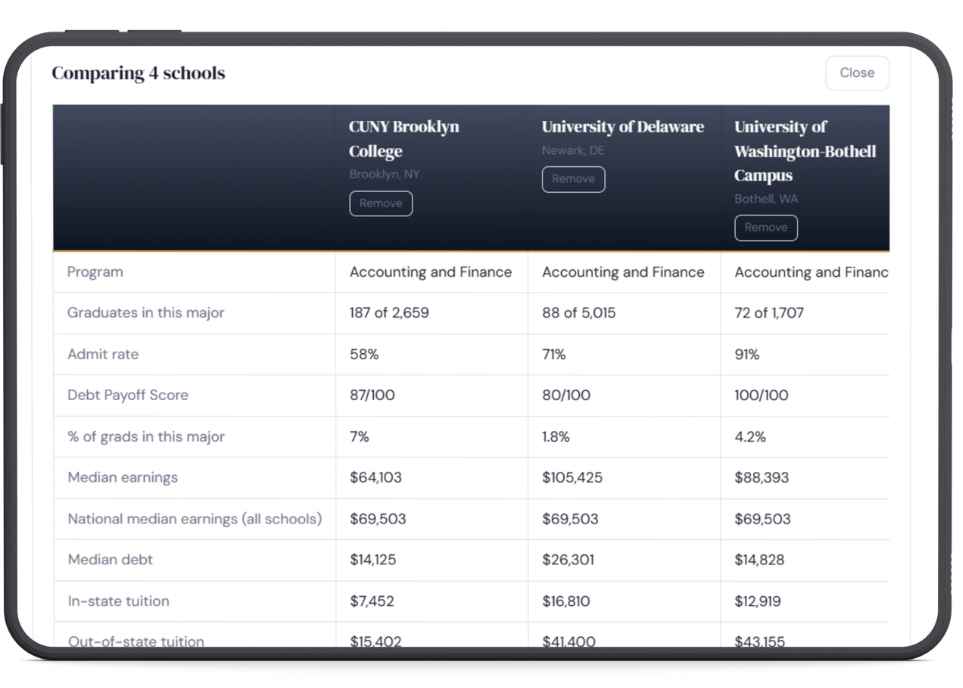
Compare Colleges & Search By Major, Free With Waystone’s College Finder
To compare colleges start by lining up six things for every school: cost, admissions, academics, outcomes, financial aid and campus fit. Use the same real data each time.
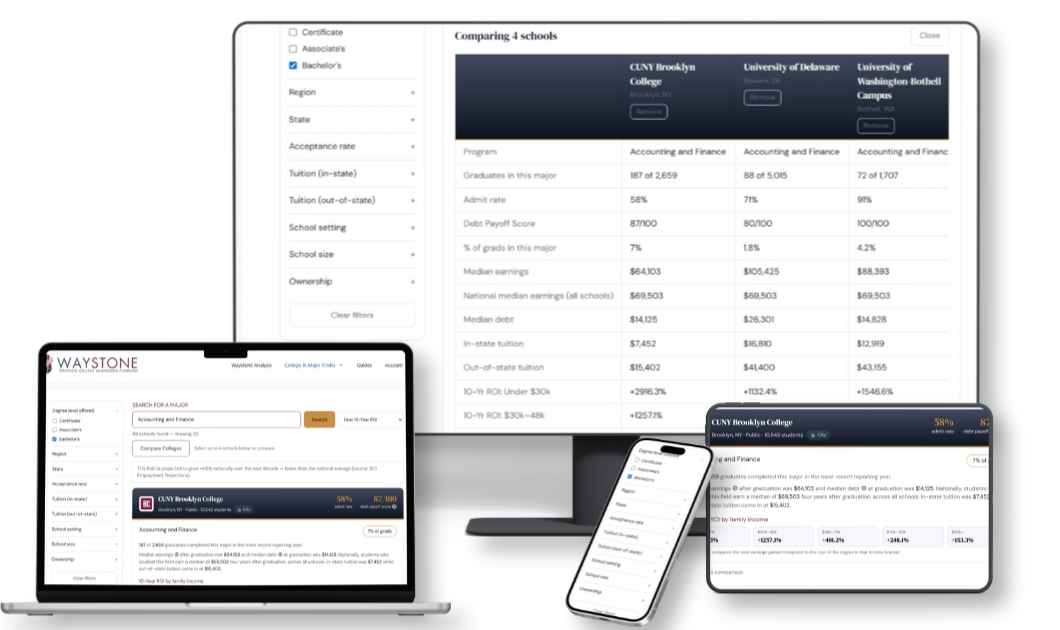
Most families compare colleges by name recognition, rankings, and published tuition. But those signals do not show what your family may actually pay, or how graduates in your intended major tend to fare after college. Compare schools using the same measures: estimated net price, graduation outcomes, borrowing, and major-related earnings.
But you don’t need to guess. Waystone’s college finder allows you to compare colleges and how to turn a long list into a shortlist. You’ll see how Waystone’s College Finder pulls the same federal data for every accredited U.S. school into one place, so you’re comparing colleges on outcomes, not marketing copy.
Key Takeaways
- Comparing colleges on sticker price alone is misleading. The average net price at public four-year schools is an estimated $2,300 for 2025-26, far below the $11,950 published in-state tuition figure, according to College Board research.
- A school’s overall acceptance rate doesn’t reveal your own odds. It can look completely different program by program.
- Graduation rate, median earnings and debt-to-earnings ratio for a specific major matter more than a school’s overall reputation.
- Comparing colleges by major, not just by school name, surfaces strong programs a generic ranking list overlooks.
What to compare when you compare colleges
Six categories decide whether a college is a good match: cost, admissions, academics, outcomes, financial aid and campus fit. Most college search sites stop at the first three. That leaves outcomes and financial aid, the two categories that determine whether a degree pays off, for you to dig up yourself.
| Category | What to check |
|---|---|
| Cost | Published tuition and fees, plus the net price your family would pay after aid |
| Admissions | Acceptance rate, and how selective your specific major is, not just the school overall |
| Academics | Program strength in your major, class size, and share of graduates in that major |
| Outcomes | Graduation rate, median earnings by major, and debt-to-earnings ratio for that program |
| Financial aid | Typical aid by income bracket, not just a headline scholarship number |
| Campus fit | Location, size and setting, the category that matters least financially |
As a result, a school that looks like a safety on acceptance rate alone can turn out to be a poor financial fit. That only shows up once you compare colleges on outcomes and aid, not admissions difficulty alone. Before you rule a school in or out, pull the same six data points you’d pull for every other school:
- Published tuition
- Estimated net price
- Major-level acceptance rate
- Graduation rate
- Median earnings for your major
- Debt-to-earnings ratio.
If even one is missing, treat that comparison as incomplete. Don’t fill the gap with a guess. Most families skip this step. Instead, they compare colleges on whichever three or four numbers are easiest to find. That’s exactly how a strong-fit school gets crossed off a list too early.
How to compare colleges using real outcomes data
Waystone’s College Finder uses data from the U.S. Department of Education to enable you to find every single school across the U.S. that offers a particular major. For every match, you get the numbers that actually predict whether a degree pays off: a Debt Payoff Score showing how a school’s typical debt-to-earnings ratio for that major stacks up nationally, a real 10-Year ROI calculation weighing the true cost of attendance against expected earnings. And, because the same degree can look very different depending on your family’s financial aid picture you will also see a full breakdown of projected return by income bracket.
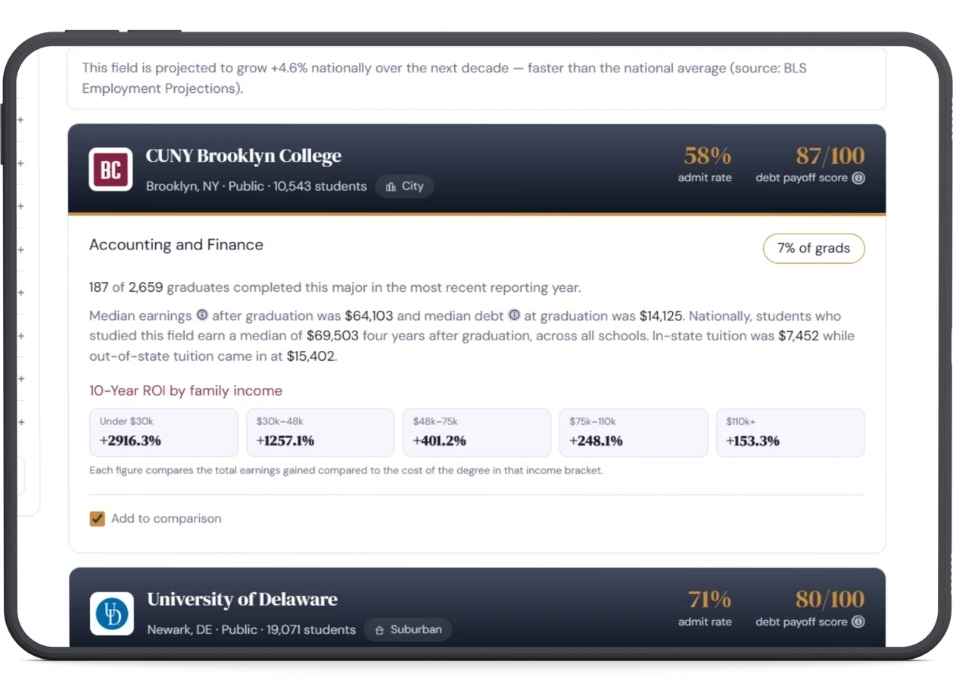
Beyond the numbers, the Finder surfaces insights most college-search tools never show. The Major Concentration Index flags “Overlooked Program, Strong Outcomes” schools — places few students choose for a given major but where graduates go on to earn top-tier incomes — right alongside “Popular Program, Weaker Outcomes” warnings for majors that draw a crowd but underdeliver financially.
Each result also links to real Bureau of Labor Statistics projections for the career field tied to that major, so you can see whether you’re stepping into a growing or shrinking job market before you commit four years to it. Add in filters for state, region, acceptance rate, tuition, campus setting, and school size, plus a side-by-side comparison tool for up to four schools at once, and the Finder turns “where should I apply for this major” from a guess into a data-backed decision.
Select up to four colleges to compare against each other.