
How to Build a College List: The Strategic 2026 Guide
What if the most dangerous thing you could do for your 2026 applications is follow the traditional advice your parents used? Building a college list in an era where Ivy League acceptance rates have plummeted to 3% requires more than it use to. You're likely feeling the crushing weight of application inflation as students now apply to record numbers of schools just to feel secure. It's a high-stakes game where one wrong guess leads to a mailbox full of rejections and hundreds of dollars in wasted fees.

You shouldn’t have to pay a $5,000 consultant to get help with building your college list. This guide gives you the data-driven framework to build a balanced list without the luxury price tag. We’ll strip away the mystery of how test-optional policies shift your odds and show you exactly how to curate a list of 8 to 12 schools that maximize your admission chances. You’ll learn how your specific extracurricular narrative changes your chances at every institution. It’s time to stop guessing and start using a strategic shortcut that works.
Key Takeaways
- Define the “Middle 50” rule using Common Data Set benchmarks to eliminate guesswork in school categorization.
- Build a high-probability college safety reach and target list of 8-12 schools that prioritizes financial security alongside academic fit.
- Identify how an “extracurricular spike” can strategically shift a reach school into your target zone.
- Use Activity Gap Analysis to pinpoint exactly what your profile is missing before senior year.
The 2026 Framework: Defining A College List
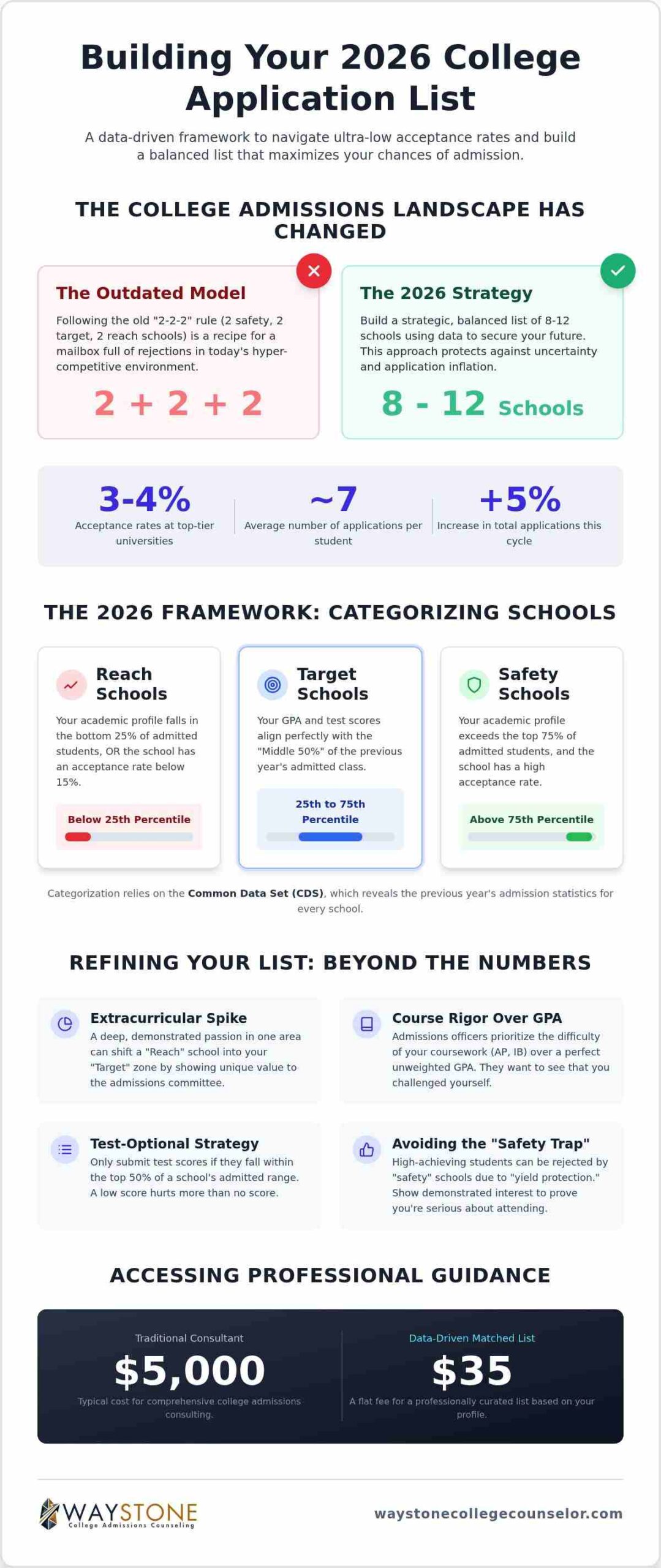
The old 2-2-2 model for building a college list is dead. Applying to two schools in each category was a safe bet a decade ago; today, it may not be enough. In a high-volume application era where students submit nearly seven applications on average, you need a data-driven college safety reach and target list that reflects 2026 reality. Understanding the college admissions process requires a cold, hard look at the numbers. Precision is your only protection against the surge in application numbers.
- Reach Schools: Any institution where your stats fall in the bottom 25% of the previous year’s class, or any school with an acceptance rate below 15% regardless of your GPA.
- Target Schools: Institutions where your GPA and test scores align with the middle 50% of the previous year’s admitted class.
- Safety Schools: Schools where your academic profile exceeds the top 75% of admitted students and acceptance rates remain high.
In 2026, the “Likely” school has replaced the traditional safety. A “Likely” school is one where the data suggests you’re a lock, but you still treat the application with the same rigor as a reach. With total applications increasing, no admissions is guaranteed without a strategic approach.
The “Reach” Reality Check
Don’t let a 4.0 GPA fool you. Schools like Harvard, Princeton, and Columbia, with acceptance rates hovering between 3% and 4%, are reaches for every single applicant. They are “statistical reaches” regardless of your resume. Test-optional policies have added more volatility to this category. You must also distinguish between an academic reach and a financial reach. If a school’s net price calculator shows a cost your family can’t meet, it’s a financial reach even if your grades are perfect.
Yield Protection and the Safety Trap
Being overqualified can actually work against you. Some institutions practice “yield protection,” where they reject or waitlist high-achieving students they suspect will never actually enroll. They do this to protect their yield rate, which is the percentage of admitted students who attend. To avoid the safety trap, you need “True Safeties” rather than “Volatile Targets.” A true safety is a school that historically admits a high percentage of students with your profile. To secure your spot, you must show “demonstrated interest.” If you don’t open their emails or engage with their admissions team, a safety school might assume you’re using them as a backup and hand you a rejection to save their stats.
The Math of Admission: Categorizing Schools by the Numbers
Admissions decisions aren’t based on a “vibe.” They’re based on spreadsheets. To build a legitimate college list, you must move beyond marketing brochures and into the raw data. The most powerful tool at your disposal is the Common Data Set (CDS). This document reveals exactly where the previous year’s admitted class landed in terms of GPA, SAT, and ACT scores. It also tells you exactly what the college considers as ‘very important’ verses somethin they don’t consider at all.
The “Middle 50” rule is your primary benchmark. This range represents the 25th to the 75th percentile of admitted students. If your scores are above the 75th percentile, the school is likely a safety. If you fall between the 25th and 75th, it’s a target. Anything below the 25th is a reach. A 3.8 GPA can be a “Safety” for one major but a “Reach” for another. Precision matters because schools don’t admit “students”; they admit “classes” with specific institutional needs.
Data Points That Move the Needle
Grades are the floor, not the ceiling. In 2026, admissions officers prioritize the rigor of your course load over a perfect unweighted GPA. They want to see how many AP or IB classes you took relative to what your school offers. Class rank also remains a critical metric for large public universities. If your school doesn’t rank, they’ll look at your GPA within the context of your specific high school’s profile. When it comes to testing, the rule is simple: only submit if your score is in the top 50% of the school’s range. Going test-optional is a strategic choice, not a sign of weakness.
Major-Specific Volatility
Your intended major is the biggest variable in defining your college list. A “Target” school for a Psychology major can easily become a “Reach” for a Computer Science or Engineering applicant. This is due to “impacted majors,” where the number of qualified applicants vastly exceeds the available seats. Many state universities have separate, much higher admission standards for their STEM programs. Some savvy applicants apply as “undecided” to increase their odds of initial entry. However, be careful; transferring into an impacted major once you’re on campus can be nearly impossible at some institutions.
Step-by-Step: How to Build Your Balanced College List
Success in admissions isn’t about the volume of applications; it’s about the precision of your selection. Applying to 20 schools leads to mediocre essays and application burnout. Your goal is a curated college list of 8 to 12 schools. This range ensures you have enough options to be safe, but few enough to maintain elite quality in every supplement you write. Quality beats quantity every time you hit submit.
Step 1: Start with the “Safety.” Establish your baseline early. Use net price calculators to find two schools that are both academically “Likely” and guaranteed to be within your family’s budget. Step 2: Identify 3 to 4 “Target” schools. These are institutions where your narrative and stats align with the middle 50% of the previous year’s class. Step 3: Add 2 to 3 “Hard Reaches.” Choose schools that align specifically with your long-term career goals, even if the acceptance rate is below 10%. Step 4: Audit for “Activity Gaps.” Before finalizing, ensure your extracurricular profile matches the institutional priorities of your top choices. If a school values community leadership and you only have solo hobbies, that school might be a harder reach than the data suggests.
The Ideal Ratio for Success
The standard 2-4-2 model (2 Safeties, 4 Targets, 2 Reaches) works for most students. It provides a solid foundation with plenty of upside. However, high-achieving students aiming for elite tiers should lean toward a 3-5-4 model. This accounts for the extreme volatility at the top of the rankings. If you’re applying Early Decision (ED), you can afford to be more aggressive with your reach count. A binding ED application can effectively shift a school’s category because of the significant boost in acceptance rates for early applicants compared to the regular pool.
Using a Personalized College List Generator
Stop using generic search engines that only filter by “Location” or “Size.” These metrics don’t get you admitted. You need to filter by “Strategic Fit.” A data-driven Activity Gap Analysis can reveal if your profile actually resonates with a school’s specific culture. A Matched School List takes the emotion out of the process, using sophisticated logic to find schools where your specific “spike” is most valued. Finally, always cross-reference your list with the total cost of attendance. A school that leaves you with massive debt isn’t a strategic win, no matter how prestigious the name on the diploma.
Refining Your List: Beyond GPA and Test Scores
A perfect GPA is no longer a differentiator; it’s a baseline. To finalize a college list that actually works, you have to look at the “soft” data that admissions officers use to break ties. This is where the “Extracurricular Narrative” comes into play. A unique talent or a specialized achievement can effectively turn a statistical Reach into a Target. Schools aren’t looking for students who are moderately good at everything. They’re building a class of specialists.
A personalized strategic report from Waystone identifies hidden narrative weaknesses of your profile You can get ahead of this by using an Activity Gap Analysis to see exactly where your profile falls short.
The Activity Gap Factor
Your high school resume is a map of your past, but it needs to be a bridge to your future. Mapping your current activities against your gaps is critical. If you’re aiming for a top tier school but lack a clear leadership narrative, your senior year is your last chance to pivot. Stop trying to be “well-rounded.” That approach is a disadvantage at Reach schools because it suggests a lack of focus. Instead, double down on your primary interest to create a “narrative” that demands attention.
Essay Narrative Alignment
The “vibe” of your target schools should dictate the tone of your essays. A narrative that works for a small, private liberal arts college will likely fall flat at a large, career-focused public research university. One essay doesn’t fit all categories on your list. You need a Strategic Narrative that connects your Safeties and Reaches through a consistent personal brand. This doesn’t mean rewriting your life story for every application. It means framing your experiences to highlight the specific traits each institution values most. Precision in your narrative ensures you aren’t just another number in the pile.
The Waystone Shortcut
The traditional college admissions industry is built on a foundation of high costs and gatekeeping. For years, families have felt forced to pay $5,000 or more for private consultants just to get a balanced college list. This outdated model relies on human intuition. Today, savvy families are ditching these expensive services for a streamlined, modern alternative. Waystone offers a sophisticated, AI-powered solution at a cost that is affordable. It’s a disruptive shift that replaces mystery with clarity and high barriers with accessibility.
AI Precision vs. Human Bias
Human bias is a liability in list-building. Consultants often have “favorite” schools or outdated perceptions of what a “target” looks like in the current admissions climate. Algorithms don’t have feelings or regional preferences. They objectively map your profile against real-time admission trends to find your best-fit targets. This removes the emotional exhaustion of the process. You get a strategic plan in minutes rather than weeks of expensive meetings. It’s the pragmatic choice for students who value sophisticated logic over general advice.
What You Get in Your Strategic Report
The Personalized Strategic Report from Waystone isn’t a generic PDF. It’s a roadmap designed to give you a strategic advantage. Your report includes a Matched School List, ensuring your list is balanced from the start. It also features an Activity Gap Analysis. This tool identifies exactly what your resume is missing so you can make actionable improvements before it’s to late. Finally, you receive Personalized Essay Topics. These suggestions are specifically tailored to align with your narrative.
Don’t settle for a list built on guesses and high-priced fluff. Get your Personalized Strategic Report and take control of your future with data-backed confidence.
Take Control of Your Admissions Strategy
Navigating the 2026 application cycle requires a shift from hope to strategy. You now have the framework to categorize schools by raw data and the insight to use your extracurricular narrative as a competitive lever. A balanced college list is your insurance policy against a record-breaking year of application volume.
Frequently Asked Questions
How many safety schools should be on my college list?
You should aim for 2 to 3 safety schools on your college list. At least one of these must be a “financial safety” where you are guaranteed admission and the cost is certain to fit your budget. Don’t treat these as throwaway options. Every school on your list should be a place you would actually attend. In an era of high application volume, having a solid foundation prevents you from ending up with zero choices.
Can a school be a safety for one student and a reach for another?
Absolute categories don’t exist in admissions. A school is a safety if your academic profile exceeds the top 75% of admitted students. For a student with a 3.9 GPA and a 1550 SAT, a large state university might be a safety. For a student with a 3.2 GPA, that same university becomes a reach. Your category is determined by how your specific data points align with the institution’s previous year’s admitted class data.
What is the difference between a target school and a reach school?
The distinction lies in the probability of admission based on data. A target school is one where your GPA and test scores align with the middle 50% of the previous year’s class. A reach school is any institution where your stats fall in the bottom 25%, or any school with an acceptance rate below 15%. Even if your grades are perfect, hyper-selective schools remain reaches because the sheer volume of applicants makes the outcome unpredictable.
Should I apply to reach schools if my GPA is below their average?
You should still apply to reach schools if your GPA is slightly below the average, provided you have a distinct “extracurricular spike.” Admissions officers look for specialists who fill specific institutional needs. If you’ve launched a successful business or won national awards, those achievements can outweigh a lower GPA. However, you must ensure the rest of your college safety reach and target list is grounded in schools where your academic profile is a stronger match.
Does “test-optional” change how I categorize my target schools?
Test-optional policies make target schools more volatile and harder to predict. When you remove a standardized metric, admissions officers place more weight on your transcript rigor and Activity Gap Analysis. A school that looks like a target on paper might become a reach if your extracurricular narrative doesn’t stand out. If you choose not to submit scores, your remaining application components must be flawless to maintain your standing in the target category.
How do I know if a college is a “financial reach” for my family?
A college is a financial reach if the estimated net price exceeds what your family can realistically pay without excessive debt. You can determine this by using each school’s Net Price Calculator. Don’t rely on the “sticker price” found on brochures. If the gap between the offered aid and your budget is too wide, the school is a financial reach. Secure your list by including at least two schools where the math works.
What is yield protection, and how does it affect my safety list?
Yield protection occurs when a safety school rejects or waitlists overqualified students they suspect won’t enroll. These institutions protect their “yield rate” by only admitting students who are likely to attend. To avoid this trap, you must show demonstrated interest by engaging with their admissions team. A true safety isn’t just a school where you have high stats; it’s a school that historically values and admits students with your profile.
Is a 10% acceptance rate school ever a “target” for a 4.0 student?
No institution with a 10% acceptance rate is ever a target school. Even for a student with a perfect 4.0 GPA and maximum rigor, these schools are statistical reaches. The math is simple: when a school rejects 90% of its applicants, most of whom are highly qualified, no one is a “safe” bet. Categorizing these schools as reaches ensures your list remains balanced and protects you from the unpredictability of hyper-selective admissions cycles.