
How to Build a Strategic College Application Plan for 2026 Success
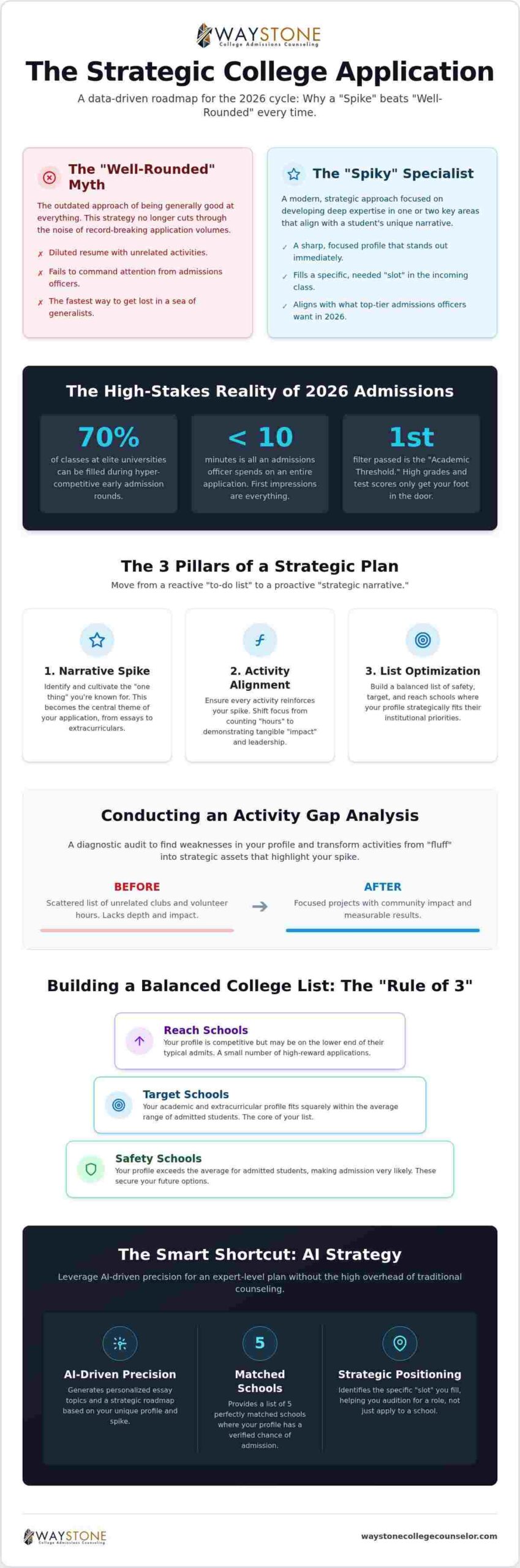
The "well-rounded" applicant is a myth that's costing you an acceptance letter. In an era where elite universities fill up to 70% of their classes through early rounds, being generally good at everything is the fastest way to get rejected. You don't need a longer resume; you need a sharper edge. The 2026 cycle is more data-driven than ever, and a generic approach is no longer enough to cut through the noise of record-breaking application volumes.

You’re likely feeling the weight of this shift. Between rising application fees and the sudden return of mandatory SAT scores, the process feels like an expensive maze designed to keep you out. It’s exhausting to wonder which extracurriculars actually move the needle or if your essay narrative is unique enough to stand out. You deserve a path that values your time and your family’s resources while maximizing your results.
This guide transforms that uncertainty into a high-leverage strategic college application plan. You’ll learn how to identify critical activity gaps, build a balanced school list based on real admission odds, and develop a narrative that commands attention. We’re stripping away the mystery of the admissions office and replacing it with a clear, actionable roadmap for 2026 success.
Key Takeaways
- Shift your focus from being “well-rounded” to being a specialist to align with what top-tier admissions officers actually want in 2026.
- Use an Activity Gap Analysis to pinpoint weaknesses in your profile and build a strategic college application plan that highlights your unique narrative.
- Implement the “Rule of 3” to construct a balanced list of safety, target, and reach schools where you have a verified chance of admission.
- Leverage AI-driven precision to generate personalized essay topics and strategic roadmaps without the high overhead of traditional private consulting.
What is a Strategic College Application Plan?
A strategic college application plan isn’t a simple calendar of deadlines. It’s a precise, data-driven roadmap. It aligns a student’s unique profile with the right college. For decades, parents were told that being “well-rounded” was the goal. That’s a myth. Admissions officers aren’t looking for a class of generalists; they’re looking for a “well-rounded class” made of individual specialists. They want students who bring a specific, high-level skill or perspective to their campus.
A winning plan rests on three core pillars: a narrative spike, activity alignment, and list optimization. A narrative spike is the “one thing” your teen is known for. Activity alignment ensures every extracurricular reinforces that spike rather than diluting it. List optimization ensures you aren’t wasting time and fees on schools where the student’s profile simply doesn’t fit the institutional priorities. This moves the application from a reactive “to-do list” to a proactive “strategic narrative.” It’s essential to understand how the U.S. college admissions process has shifted from holistic vibes to data-heavy selection criteria.
Why Grades and Test Scores Are Only the Baseline
Think of grades and test scores as the “Academic Threshold.” They get your foot in the door, but they don’t get you a seat at the table. Selective colleges use these metrics to filter out thousands of applicants before a human ever reads an essay. Once that threshold is met, the numbers lose their power. Admissions teams then look for course rigor. They want to see that a student didn’t just get an A, but they got an A in the hardest classes available. If your teen’s transcript looks like everyone else’s, the numbers won’t save them. You need a strategic college application plan to differentiate the student once the data filters have done their job.
The Shift from ‘Applying’ to ‘Positioning’
Positioning is the art of identifying the specific “slot” a student fills in a freshman class. You aren’t just “applying” to a school; you’re auditioning for a role. Maybe your teen is the community organizer, the niche researcher, or the innovative coder. Identifying this unique value proposition early is the key to standing out. A strategic college application plan helps you lock in this identity long before the first deadline. This clarity is a massive stress-reliever for families. Instead of the chaotic scramble of senior year, you have a clear path. You know which activities matter and which are just noise. It’s the “smart shortcut” to a competitive edge.
Conducting an Activity Gap Analysis to Stand Out
Admissions officers spend less than ten minutes reviewing an entire application. If your teen’s profile is a scattered list of unrelated clubs and volunteer hours, the reader will lose interest before they finish the first page. An Activity Gap Analysis is a diagnostic audit of a student’s extracurricular profile. It identifies the “holes” in a resume before an admissions officer does. Instead of guessing what might look good, this analysis uses data to determine where a student’s involvement lacks the depth or impact required for a competitive strategic college application plan.
The goal isn’t to add more activities; it’s to subtract the fluff. We move away from “hours” and toward “impact.” If a student has spent three years in a club but hasn’t led a project or changed an outcome, that activity is stagnant. We audit current involvements to see if they can be transformed into strategic assets. A simple hobby, like coding or gardening, can become a powerhouse project-based learning opportunity if it’s scaled to include community impact or measurable results. While you manage these high-level profile shifts, don’t forget the administrative side of the cycle, such as reviewing the official FAFSA guide to ensure your logistical timeline is as sharp as your student’s resume.
Identifying Your Narrative Spike
Universities prioritize students with a narrative over well-rounded ones. For a STEM student, this might mean a published research paper on niche isotopes. For a humanities student, it could be the creation of a digital archive for local oral histories. Even a standard activity like varsity sports can be pivoted. A captain doesn’t just “play” a sport; they might develop a mentorship program for junior athletes. This positioning turns a generic extracurricular into a unique narrative that fills a specific “slot” in the incoming class. Identifying this spike early allows you to focus your resources on what actually moves the needle.
Filling the Gaps Before Senior Year
Strategic summer planning is the most effective way to reinforce a narrative spike. Don’t waste the summer on generic “leadership camps” that thousands of other students attend. Instead, seek out missing evidence of community impact or specific leadership roles that align with the student’s chosen identity. If the profile lacks a “leadership” signal, the summer is the time to found an initiative or take over a significant project. An activity gap report provides a data-backed diagnostic that saves families months of costly guesswork by identifying exactly where a student’s profile lacks the competitive weight needed for elite admissions. You can start this process today by generating an Activity Gap Analysis to see where your teen stands. This proactive approach ensures that by the time senior year arrives, the student isn’t just another applicant; they’re a specialist who is impossible to ignore.
Building a Balanced College List: Safety, Target, Reach
Applying to college without a balanced list is like betting your future on a single spin of a roulette wheel. A strategic college application plan demands a “Rule of 3” approach. You need at least three schools in every category: Safety, Target, and Reach. This structure ensures that no matter how the admissions data shifts, your teen has a clear path forward. Without this balance, families often find themselves in April with a handful of rejections and no viable options.
Safety schools are better described as “Likely” schools. A true likely school is one where your student’s GPA and test scores sit comfortably in the top 25% of the previous year’s admitted class. If the school also has a high overall acceptance rate, it serves as a solid foundation for the entire list. Target schools are those where the student’s metrics match the middle 50% of the class. This is the 25th to 75th percentile range. It’s a fair fight, but it’s never a guarantee. Reach schools include “Ivy+” institutions or any school with an acceptance rate below 10%. Regardless of a student’s stats, these are low-probability math problems. They require the narrative spike we discussed earlier to even be considered.
The Math of Admission Probability
Historical data is your best weapon. Many families make the mistake of using national rankings as their only guide. Rankings are generic, but your student’s data is specific. What might be a “Reach” for a student with a 3.5 GPA could be a “Safety” for a student with a 4.0 and a niche research spike. Using a data-driven tool to generate a Matched School List removes the emotional bias. It prevents the generic mistakes that lead to a “thin” list and late-season panic. Precision here is the difference between a successful cycle and a wasted year.
Finding ‘Fit’ Beyond the Rankings
Prestige chasing is a high-risk game with low rewards if the student doesn’t thrive. If a school’s culture or financial cost doesn’t align with your family’s reality, it isn’t a fit. You must evaluate academic rigor, social environment, and financial outcomes. A strategic backup isn’t a consolation prize; it’s a calculated move. A precisely Matched School List saves thousands in wasted application fees by eliminating schools where the student has no statistical chance or genuine interest. It turns the process from a hopeful guess into a targeted strike.
The Smart Shortcut: AI Strategy vs. Traditional Counseling
Traditional college counseling has become a gatekeeper. It’s a high-stakes, high-cost industry where families are often pressured into spending $5,000 or more for basic guidance. This creates a massive barrier for the average family. You’re often paying for a human’s limited time and subjective intuition. The AI revolution has disrupted this model. It provides the same high-level logic and strategic foresight as a top-tier consultant but does so in minutes. This is the smart shortcut for families who want professional results without the predatory pricing or high-pressure sales pitches.
The efficiency of data-driven strategy is unmatched. While a human counselor might take weeks to audit a student’s profile, a machine analyzes thousands of data points instantly. This speed allows you to move from confusion to execution in a single afternoon. It empowers the DIY family to take control of the process with the same caliber of intelligence used by elite private firms. You don’t need a middleman; you need a roadmap.
Democratizing College Admissions
Technology is the great equalizer. In the past, only the wealthiest applicants had access to a sophisticated strategic college application plan. Now, data-driven school matching is more accurate than human guesswork. A computer doesn’t get tired or miss a new trend in admissions data. It analyzes thousands of variables to find the perfect fit for your teen. A flat-fee report is the most efficient investment you can make in their future. It removes the mystery and replaces it with a clear, actionable path that levels the playing field for middle-class families.
When a Strategic Report is Better Than a Human
AI doesn’t have “favorite” schools. Human counselors often push students toward familiar institutions or regional favorites based on their network. An AI strategic report analyzes every accredited four-year college in the U.S. simultaneously. You get a comprehensive analysis that no human could replicate in a lifetime. The output is a clear PDF roadmap you can start using today. There’s no waiting for a follow-up meeting or a revised draft. You get the intelligence you need to execute your strategic college application plan immediately. If you’re ready to skip the high fees and get started now, you can get your personalized strategic report in just a few clicks.
Executing Your Strategy with Waystone’s AI-Powered Report
Strategy is useless without execution. Once you’ve moved past the “well-rounded” myth and identified your narrative spike, you need a tool to keep your efforts on track. Your Personalized Strategic Report acts as the “North Star” for your entire 2026 cycle. It isn’t just a document; it’s a living roadmap. By following the Waystone workflow, you input your teen’s GPA, test scores, and interests to receive a comprehensive plan in minutes. This removes the friction of the strategic college application plan and allows you to focus on high-impact actions rather than administrative guesswork.
The transition into junior year is the most critical window. This is when you implement the findings from your Activity Gap Analysis. If the report identifies a lack of leadership evidence, you have a clear mandate to seek out specific roles or projects. You aren’t just “doing things” anymore. You’re building a profile with surgical precision. This methodical approach ensures that every hour spent on extracurriculars directly increases your admission odds at the schools on your Matched School List. It replaces the feeling of being overwhelmed with a sense of high-level competence.
Turning Report Insights into Essay Gold
Admissions officers are looking for narrative threads. They want to see a consistent story that connects your academic interests to your extracurricular impact. Your report provides Personalized Essay Topics that help you find this narrative. Instead of a generic personal statement about “hard work,” you’ll move toward explaining “why it matters.” You’ll use AI-suggested prompts to brainstorm unique stories that highlight your spike. This shift turns a standard essay into a compelling argument for why you belong in a specific freshman class. It’s the difference between being a name on a transcript and a person an admissions officer wants to meet.
Your Next Steps for a Stress-Free Application Season
The path to 2026 success is now visible. Your first step is to download your Matched School List and begin scheduling campus tours for the institutions that truly fit your profile. Simultaneously, you should finalize your extracurricular resume by filling the specific holes identified in your gap analysis. This isn’t a season for panic; it’s a season for precision. You have the data, the strategy, and the roadmap. Now, you just need to follow it.
Secure Your 2026 Admission Strategy Today
The admissions landscape for 2026 is a data-driven competition. You can’t rely on being “well-rounded” anymore. Success requires a narrative spike that makes your teen the obvious choice for a specific slot in the freshman class. By identifying activity gaps early and building a list based on real probability math, you remove the guesswork that leads to rejection. This isn’t just about applying; it’s about positioning.
Implementing a comprehensive strategic college application plan is the only way to cut through the noise of record-breaking application volumes. You don’t need a $5,000 consultant to get professional-grade results. You need precision. Get Your Personalized Strategic College Report and access data-driven matched school lists and comprehensive activity gap analysis instantly. It’s the most efficient investment you can make in your student’s future. You have the tools to navigate this process with confidence. Take the shortcut to a stress-free application season and start building that roadmap today.
Frequently Asked Questions
What is the best time to start a strategic college application plan?
The ideal time to start is freshman or sophomore year. Starting early allows you to architect a narrative spike rather than scrambling to fix a generic profile during senior year. A strategic college application plan requires time to execute high-impact projects and secure leadership roles. If you wait until the last minute, your options are limited to what’s already on the transcript. Starting early turns a stressful process into a methodical journey toward a top-tier acceptance.
Do I really need a private counselor to get into a top-tier school?
You don’t need a high-priced private counselor to succeed at elite universities. While traditional consultants charge thousands for advice, modern technology provides the same strategic logic using objective data. You can access professional-grade insights, like school matching and gap analysis, without high fees. This levels the playing field for families who want elite results without the elite price tag. It’s about having the right information, not a human middleman.
How does an activity gap analysis help my college application?
An activity gap analysis functions as a diagnostic audit of your student’s profile. It identifies exactly where their resume lacks the “signals” that admissions officers prioritize, such as leadership or community impact. By spotting these holes early, you can course-correct with specific projects that reinforce your narrative spike. This turns a scattered list of clubs into a cohesive, high-leverage resume that commands attention in a crowded applicant pool. It’s a smart shortcut to standing out.
What is the difference between a safety school and a target school?
A safety school, or “likely” school, is an institution where your student’s GPA and test scores sit in the top 25% of the admitted class. These schools should also have high overall acceptance rates. A target school is one where your metrics match the middle 50% of the previous year’s class. While you’re a competitive applicant for a target school, admission is never a guarantee. A balanced strategic college application plan requires at least three of each.
Can an AI really provide better college advice than a human?
AI provides a level of precision that human intuition can’t match. It analyzes thousands of data points across every U.S. college instantly, removing the regional bias or “favorite” schools that many human counselors have. Because it’s powered by rigorous methodology rather than general advice, it identifies matched school lists based on actual admission probability. It’s a faster, more affordable way to build a plan that’s backed by hard data rather than guesses or outdated trends.
How do I find a unique essay topic if my life feels ‘normal’?
You don’t need a tragic or extraordinary life story to write a winning essay. Admissions officers look for narrative threads that show intellectual curiosity or impact. A strategic report identifies these threads by looking at your activities and interests. It moves the focus from “what you did” to “why it matters.” By using personalized topic suggestions, you can find a unique angle in everyday experiences that perfectly aligns with your student’s chosen narrative spike.
What should be included in a personalized strategic report?
A comprehensive strategic report should include three essential components. First, a matched school list categorized by admission probability. Second, an activity gap analysis that identifies missing leadership or impact signals. Finally, it should provide personalized essay topic suggestions that align with your student’s unique profile. This combination creates a 360-degree roadmap that strips away complexity and provides a clear path to execution. It replaces confusion with a results-oriented lens.
Is it too late to start a college plan in senior year?
It’s never too late to optimize, but the strategy changes in senior year. You can’t magically add three years of leadership, but you can refine your positioning. A strategic plan at this stage focuses on list optimization and narrative alignment. You’ll ensure your essays highlight the best parts of your existing profile and that you’re applying to schools where your data actually fits. It’s about playing the hand you have with maximum efficiency and tactical precision.